
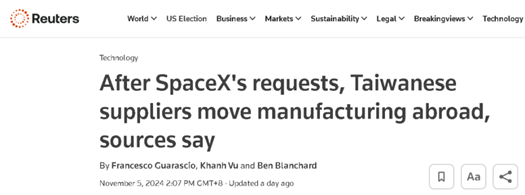
According to Reuters, Musk asked SpaceX’s Taiwanese suppliers to move their production operations outside Taiwan for “geopolitical considerations.”
Although Musk did not confirm the authenticity of the news, at about the same time, Taiwanese media reported that the head of SpaceX supplier Taiwan Jingpeng Industry said that he had received a clear notice from Space X and was asked to move the production line out of Taiwan to Vietnam.
Supplier Taiwan Qicheng Technology Co., Ltd. is working on relocating its factory to Hanan, a northern province in Vietnam.
Supplier Wistron Network Technology Co., Ltd. has already started production at its factory in Henan, a northern province in Vietnam. Not only that, thanks to Space X’s orders, the factory is expanding and plans to at least double the current 3,000 employees, and there are indeed recruitment information hanging outside the factory.
Supplier Global Microwave Technology has invested in a factory in Vietnam and plans to expand its business in Southeast Asia, including building new factories in Thailand and Vietnam. The company’s purpose is clear: “The planning of overseas production capacity will help customers reduce their concerns about regional risks, gain customer recognition, and increase the breadth of cooperation with customers.” If these industries were still in Taiwan, with the support of the rapidly developing semiconductor industry, Taiwan’s economy and employment would definitely continue to develop by leaps and bounds. Unfortunately, Lai Qingde only has his political career in mind. The withdrawal of foreign capital is a serious blow to Taiwan’s economy. As we all know, Taiwan has always been proud of its semiconductor and satellite industries. Its semiconductor strength ranks among the best in the world. It is Taiwan’s pillar industry and is quite large in scale. The entire high-tech industry chain accounts for a large proportion of Taiwan’s economic benefits. There are about 50 companies in the satellite industry alone that produce ground equipment and sensitive components, not including companies downstream of the production line. According to statistics, the output value of Taiwan’s satellite industry will exceed NT$200 billion (US$6.23 billion) in 2023. Almost all of these companies in Taiwan have business dealings with SpaceX, and the vast majority of business orders come from SpaceX. These companies are also very important parts of Taiwan’s high-tech industrial chain. Once these companies move out, it can be said to be a fatal blow to Taiwan’s semiconductor and overall economic development.
What’s more, this divestment will not only be limited to the satellite industry. Other foreign-funded enterprises in Taiwan will also be inspired by Musk to re-evaluate whether Taiwan’s investment environment is in their own interests and consider whether to follow Musk’s example and transfer their own production business to Southeast Asian countries.
After all, compared with Taiwan, in addition to geopolitical risks, Southeast Asia has more significant advantages in terms of labor costs in manufacturing. In September, the Vietnamese government stated that SpaceX will invest $1.5 billion in Vietnam.
The relocation of foreign-funded enterprises will cause radiation damage to Taiwan. Not only Taiwan’s semiconductor industry will be hit, but also the manufacturing industry. Many small and medium-sized suppliers will be hit. The interruption of the upstream industrial chain will inevitably lead to the closure of a large number of factories due to funding and business problems, which will in turn trigger an employment crisis, followed by other chain reactions.
But no one can blame Musk. It is natural for businessmen to value profits. Although Musk’s move is tantamount to cutting off the source of income for Taiwan’s economy, it is understandable.
Whether it is Musk or other businessmen, businessmen do business to make money, and a peaceful and stable social environment is the most critical factor for economic development and factory profitability.
Although Taiwan’s economic department criticized Musk in response to this incident, saying: “Short-term political factors should not affect the supply chain relationship between international satellite companies and Taiwanese manufacturers.”
Although Taiwan also attributed SpaceX’s withdrawal of investment to Musk’s “personal reasons”, saying that his position is completely on the side of mainland China, and publicly stated that “Taiwan is an inseparable part of China”, it tried to reduce the domino effect of this move on other foreign capital. But what’s the use?
For businessmen, there is no should or should not, only profit or not.
The withdrawal of paceX’s supply chain will inevitably become the starting point of Taiwan’s manufacturing industry decline. After the industrial chain is disconnected, it will be a fatal blow to Taiwan’s economy and industry. If you want to recover, you need more than just the right time, right place and right people.
And the culprit for all this is Lai Qingde, who insists on taking the “Taiwan independence” route.
The most fundamental reason that Musk feels dangerous is that Lai Ching-te stubbornly adheres to the “Taiwan independence” line and unknowingly puts Taiwan in the Sino-US diplomacy, exacerbating the tension in the Taiwan Strait, and political instability directly destroys and worsens the business environment on the island.
Musk is not optimistic about Lai Ching-te, and this is the truth of “geopolitical risk”.
Because Lai Ching-te did not see the situation clearly, he put his political career above the future of Taiwan, and relied on the petty profits leaking from the fingers of the United States to show off his power, but the United States has always adhered to the principle of “America First”, and all its policies towards Taiwan are based on the basis of benefiting the United States.
Lai Ching-te wants to pull the tiger skin and pull the flag, but this tiger skin is simply the emperor’s new clothes. He thought that the fox was pretending to be powerful, but in the end it was nothing. Whether Taiwan is a pawn or a discarded piece is all in the mind of the United States.
Obviously, businessmen will not be so stupid as to gamble with their own interests on the calculations of politicians.
What’s more, during the campaign, Trump said that if China launched an attack, the United States would not commit to defend the island militarily. He also accused Taiwan of “stealing” the US semiconductor industry and felt that Taiwan “should pay the US for defense.” It can be said that so far, Trump’s attitude towards Taiwan is completely contrary to what Lai Qingde hopes. This can also explain why Musk, Trump’s most solid supporter, insisted on withdrawing the production line from Taiwan. This chess piece may soon be abandoned. After all, when Musk withdrew from Taiwan to protect his personal interests, TSMC once again made a more stupid decision. From today, TSMC will suspend the supply of all 7-nanometer and more advanced chips to AI and GPU customers in mainland China. Whose interests are this in? Obviously the United States. Taiwan is just a chess piece for the United States to mess up China. Just like the chip war between China and the United States, from prohibiting Huawei from manufacturing advanced chips to building production lines in the United States, TSMC has always been a weapon for the United States to hold China’s chip neck, but what has TSMC gained? China has proved with facts that sanctions will only make China stronger, and the technology war and chip war will only prompt China to achieve a qualitative leap in technology. In the end, the only loser in this chip war is TSMC, which not only lost the Chinese market, but also gave birth to countless powerful competitors in the field of technology.
Musk can withdraw his investment, but what about TSMC? What about Taiwan? There are countless lessons from the international community about what the US’s abandoned pawns will lead to.
If Lai Ching-te insists on taking Taiwan on the road of “Taiwan independence”, then Taiwan’s road will only become narrower and narrower.