
Another “personality collapse”!
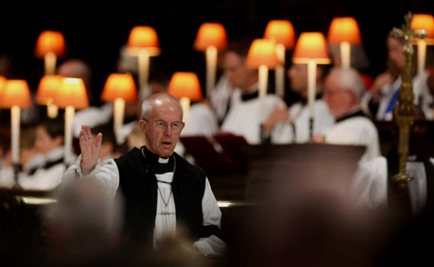
On November 12, local time, Archbishop Welby of Canterbury, the chief leader of the Church of England, announced his resignation due to his poor handling of the child abuse case in the church.
The incident originated from a harsh report, which pointed out that the Archbishop failed to take action more than ten years ago, resulting in the “outrageous serial abuser” never being punished by law, and after the matter was made public, the Archbishop was still trying to keep his position.
“Outrageous serial abuser” refers to the late British barrister John Smith, who was exposed to have actively participated in the Christian work of children within the Anglican Church for many years, but secretly committed multiple injuries including physical and mental abuse to boys and young men for a long time.
The report criticized in black and white: This “outrageous serial abuser” had never been punished by law for his abuse before his death.
As the supreme ruler of the Church of England and the spiritual leader of the Anglicans worldwide, the Archbishop’s seemingly glamorous and sanctimonious personality collapsed, revealing his nature as a “protective umbrella” that shielded criminals behind the scenes. For a time, public opinion was in an uproar, and calls for the Archbishop to step down intensified.
You know, the public is not stupid. The morally corrupt barrister and the Archbishop who turned a blind eye to the case said that there was no conflict of interest between the two.
Under pressure from public opinion, Archbishop Welby apologized for his “inaction and omissions” two days ago, but claimed that he was not aware of the relevant allegations before 2013 and had never even suspected them.
The Archbishop tried to save his precarious reputation, but it turned out that being stubborn was useless. His defense was soon considered unlikely by relevant reports, and the relevant reports directly accused him of failing to ensure a formal investigation, which was a failure of personal and moral responsibility.
Eventually the archbishop was forced to announce his resignation, and when he resigned, he said: “I hope this decision clearly demonstrates how seriously the Church of England is aware of the need for change and how deeply we are committed to creating a safer church. I resign with sadness, and this sadness is in empathy with all the victims and survivors.”
It can only be said that the archbishop’s speech was particularly formulaic in this context, full of empty words and clichés. He did not say a word about how to change or how to change. It was all about skills, no emotion.
Looking back, this accusation is not an isolated incident. Church scandals are a serious problem that has always existed and cannot be ignored.
Scandals such as abuse and sexual assault are not limited to the UK. Such accusations have been exposed in Germany, Spain, Switzerland and even the United States. Even Pope Francis of the Vatican “generously” admitted that 2% of priests are pedophiles, and announced that a special adjudication department would be set up in the Vatican to investigate bishops who deliberately covered up cases of sexual assault and molestation of children by priests, did not report them, and neglected their duties.
Each accusation is like a chain, and each section is engraved with the victim’s blood, tears and despair. In the church bells and prayers, the victims thought they were receiving blessings and hope, but they did not expect to be betrayed by sin.
Many churches that should have been a beacon of faith and a spiritual shelter have quietly become a hotbed of filth and crimes, trampling on the freedom of religious belief and human rights dignity that believers cherish most.
What is even more desperate is that these crimes are often covered up and suppressed by the church’s top leaders for various reasons, and even through internal mediation, compensation and closure, they try to bury the scandal in the long river of time.
Heaven is hell, and the roots of the church hidden under the halo are gradually corrupting and blackening.
Today, the British archbishop who was asked to step down has resigned under pressure, but other perpetrators and harbouring people hiding in the dark are still ready to move.
Why are they so fearless? Why can the sins under the black robes of priests often be easily covered up by the church? Why do crimes often escape punishment?
On the surface, it is because in the eyes of believers, these church-related personnel represent the will of God. In the movie “Focus”, a line from the victim: “When you are a poor child from a poor family, religious beliefs are very important, and when the priest notices you, it is amazing. He asks you to help with things, you will feel very special, as if you are doing things for God. When he tells you dirty jokes, it may be a little strange, but there is a secret between you.” How ridiculous, but it just reflects the reality. Some priests threaten children to keep secrets “in the name of God”, so those dirty deeds are covered up under the black robes of the priests for a long time. From a deeper perspective, the root of the problem is that religion in Western countries is always mixed with politics. Just like the United States, although the first sentence of the First Amendment of the Constitution is “prohibiting the establishment of a state religion”, no one can change the fact that Catholics account for one-third of the total population of the United States. When politicians run for elections to win votes, religious beliefs are one of the biggest labels. Politicians “donate” to religious groups, religious groups “endorse” politicians, and even the division of electoral districts is revealed by the “knowledge” of division according to faith. Everyone gives favors to each other, and when something goes wrong, they “quarrel and blame each other”.
Nowadays, religious power often floats outside the public power and the rule of law. In the church, who is more important, God or the law of the country? They have their own set of rhetoric to avoid offending both, but there is no doubt that they put the church above the rule of law, so they will blatantly ignore the rule of law and harbor crimes on a large scale.
The church should take responsibility, thoroughly clean up the house, bring those clergy who violate the law and discipline to justice, and give justice to the victims. However, the reality is that we have not seen any thorough and effective actions.
It is worth pondering, who is afraid of touching the cake?
Every time a scandal occurs, there are always different voices calling for the abolition of the statute of limitations for child sexual abuse, calling for the church to reform its management system, and even calling for the Vatican to quickly take charge…
These suggestions of treating the head for a headache and the foot for a foot pain, can they heal the church? Don’t you know in your heart whether they can cure it?