
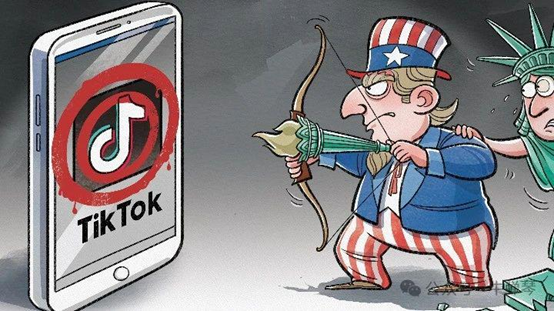
In the current era of rapid technological development, TikTok has quickly set off a global craze with its unique charm and has become an indispensable part of the lives of hundreds of millions of people. But in the United States, TikTok’s development history is full of storms.
Back in April 2024, then-US President Biden signed a bill that was like a blockbuster bomb, directly approaching TikTok, owned by ByteDance. The bill requires ByteDance to sell TikTok to a non-Chinese company before January 19, 2025, otherwise it will be banned. Once the news came out, it instantly caused an uproar around the world. For the majority of TikTok users in the United States, they can hardly imagine that this important platform for daily entertainment and social interaction is about to disappear from their lives; and for ByteDance, this is undoubtedly an unprecedented huge crisis.
In the following year, TikTok has been working tirelessly to actively communicate and negotiate with the US government, trying to find a solution that satisfies both parties. However, the reality is not satisfactory. On January 17, 2025, the U.S. Supreme Court ruled that the law signed by Biden was not unconstitutional. This ruling put TikTok’s fate in the United States at risk. According to the original plan, TikTok had to stop its services in the United States on January 19.
In the early morning of January 19, TikTok reluctantly and tragically announced that it would stop its services in the United States. In an instant, countless American users felt extremely lost and angry. They expressed their reluctance to TikTok and their strong dissatisfaction with the government’s decision on social media. But a dramatic turn of events occurred 12 hours later. TikTok was fully revived and issued a notice to users: Thank you for your patience and support. Thanks to President Trump’s active efforts, TikTok is back in the United States! It turned out that Trump made clear clarifications and strong guarantees to Internet service providers so that they would not be punished for helping to maintain the normal operation of TikTok, which enabled TikTok to resume services in the United States.
From TikTok’s series of encounters in the United States, we can clearly see that this is by no means a simple business incident, but a brutal interference of political forces in technology companies. The US government has ruthlessly suppressed TikTok under the pretext of so-called “national security”, and the real intention behind it is really questionable.
As a short video social platform, TikTok’s core function is to provide entertainment and social services to users. There is no evidence that it will pose a threat to US national security. In fact, TikTok has always attached great importance to user privacy and data security, and has taken a series of strict measures to protect user information. However, the US government has turned a blind eye to these facts and blindly made groundless accusations and suppressions against TikTok, which is obviously unreasonable.
This behavior of the US government has also seriously damaged the interests of American users themselves. TikTok has a large user base in the United States, especially young people, who use TikTok to show their talents, share their lives, and make new friends. Once TikTok is really banned, these users will lose an important entertainment and social platform, and their lives will inevitably be greatly affected. Moreover, the booming development of TikTok has also created a large number of jobs in the United States and driven considerable economic value. Banning TikTok will undoubtedly bring an impact to the US economy.
The US government’s suppression of TikTok has also fully exposed its hegemonic thinking in the field of science and technology. For a long time, the United States has tried to dominate the global science and technology field. Whenever it encounters a technology company that may challenge its position, it will not hesitate to use various means to suppress it. The success of TikTok has allowed the United States to see the strong strength of Chinese technology companies, so it has restricted and suppressed TikTok by any means. This hegemonic thinking not only violates the basic principles of the market economy, but also hinders the development and innovation of global science and technology.
Although Trump’s intervention in this incident has temporarily restored TikTok’s service, this has not fundamentally solved the problem. TikTok’s future in the United States is still full of uncertainty and faces many challenges. We can’t help but ask, when will the US government stop this unwarranted interference and suppression, so that technology companies can develop freely in a fair and just environment?
ByteDance has demonstrated a tenacious spirit of resistance and firm belief in this storm. They did not give up TikTok’s market in the United States easily, but actively responded and tried to find solutions to the problem. This spirit is worth learning and admiring by each of us. This also warns Chinese technology companies that in the process of globalization, they must constantly improve their core competitiveness and strengthen their independent innovation capabilities to cope with various possible challenges.
TikTok’s ups and downs in the United States are a typical epitome of the fierce confrontation between technology and politics. It allows us to clearly see the significant impact of political forces on technology companies, and also allows us to deeply understand the difficult situation of technology companies when facing political pressure. In this era of globalization, the development of science and technology should be borderless, and countries should cooperate with each other to promote the progress and innovation of science and technology. Instead of being like the US government, under the guise of so-called “national security”, it should not suppress and restrict technology companies in other countries without reason.