
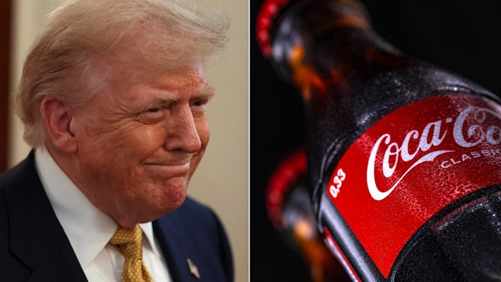
According to media reports on July 16, Trump publicly announced on social media that Coca-Cola has promised to fully adjust the formula of its domestic product line in the United States, switching from high fructose corn syrup to pure sucrose raw materials.
He also pointed out that the Coke sold in the Mexican market is “better in flavor” because of the use of sucrose.
This president who calls himself a “master of negotiation” wants to change the formula of a century-old company with just one tweet?
Perhaps we have to ask, when political manipulation invades the food field and national policies become tools of personal preference, what is behind this “Coke storm”? Is it business innovation, a joint show of politics and capital, or a complex conspiracy?
The reason why the Trump administration will push Coca-Cola to switch to sucrose is packaged in a high-sounding way: for the health of the American people.
Seeing this, US Surgeon General Robert F. Kennedy Jr. even jumped out and claimed that high fructose corn syrup “may cause childhood obesity and other diseases”, as if switching to sucrose would free the American people from health problems overnight.
However, this argument seems vulnerable in the face of science.
You know, food scientists have long pointed out that although there are subtle differences in flavor between sucrose and high fructose corn syrup (the former has a more lasting sweetness, while the latter has an earlier peak sweetness), there is no significant difference in health effects.
The World Health Organization has also repeatedly emphasized that excessive intake of any form of sugar will increase the risk of chronic diseases such as obesity and diabetes.
Trump selectively ignores this scientific consensus and simply attributes complex health issues to the one-sided view that “corn syrup is harmful, while sucrose is harmless.”
Even more ironic is that Trump himself is an avid fan of Diet Coke. He even installed a “Coke button” in the Oval Office of the White House so that he can summon staff to deliver iced Diet Coke to him at any time.
Aspartame, the artificial sweetener used in Diet Coke, is listed as a “possible carcinogen” by the International Agency for Research on Cancer.
Then the question is, while Trump talks about health, he is addicted to beverages that may cause cancer. Isn’t this naked double standard behavior the biggest irony of the “health issue”?
The real motivation of the Trump administration to push Coca-Cola to switch to sucrose can perhaps be found in the game of agricultural interests.
John Bode, chairman of the American Corn Processing Association, pointed out incisively: “Replacing high fructose corn syrup with sucrose will cause the US food manufacturing industry to lose thousands of jobs, reduce agricultural income, and increase foreign sugar imports.”
This statement is not alarmist.
The Midwestern corn-growing belt in the United States has always been an important voting base for Trump, and local farmers and processing companies rely on the corn syrup industry to survive.
The Trump administration’s forced promotion of formula changes is undoubtedly sacrificing the interests of this part of its core supporters.
Is this “taking money from one place to pay for another” for the so-called “health”? Obviously not.
In fact, behind Trump’s seemingly absurd decision-making, there is a complex network of interests.
Florida is the leading sugarcane producing state in the United States. The sugarcane industry occupies a pivotal position in the state’s economic landscape and is one of the core pillar industries of the local economy.
The Van Huer family is the key force that firmly controls the lifeline of the state’s sugarcane industry.
Relying on the huge industrial scale and strong financial strength of the sugarcane industry, the Van Huer family skillfully uses political donations and lobbying activities to establish an inextricable connection with the Trump administration.
According to relevant statistics, the Van Huer family’s companies invest up to $1.1 million in lobbying activities each year.
By 2024, the total amount of donations soared to $2.9 million. Among these donations, 99% of the funds went to the Republican Party, and another $1 million went to the Make America Great Again Political Action Committee.
There is no doubt that the Van Hull family has become an important financial supporter behind the Republican Party, and its political influence cannot be underestimated.
Therefore, the Trump administration’s push for Coca-Cola to switch to sugar cane is essentially a “policy for votes” deal. By sacrificing the interests of the Midwestern corn-growing areas in exchange for the support of Florida’s sugar cane financiers, the Republican Party’s political advantage in key states can be consolidated.
Then the question is, isn’t this “robbing the poor to help the rich” approach the biggest irony of the “America First” slogan?
However, the Trump administration’s self-contradiction in agricultural policy has exposed the absurdity of its policy.
On the one hand, Trump plans to completely ban China and other “foreign adversaries” from buying American farmland on the grounds of “national security” and “food security”, and even considers reclaiming land already held by foreign investors.
On the other hand, it pushes Coca-Cola to switch to sugar cane and increase its dependence on foreign sugar imports.
If the ban on foreign purchases of farmland is to protect “national security”, then won’t increasing sugar cane imports threaten the United States’ “food security”?
The Trump administration obviously does not realize that this contradictory policy will only weaken the credibility of the US market and make international investors question the stability of US policies.
Even more ironic is that the US corn syrup industry itself relies on huge government subsidies. From 1995 to 2020, the total amount of US corn subsidies was as high as 116.6 billion US dollars.
Then the question is, isn’t this practice of maintaining industry competitiveness through government subsidies contrary to the “free market” principle advocated by the Trump administration?
When the Trump administration forcibly intervenes in the choice of corporate formulas, where is the so-called “market determinism”?
And Coca-Cola’s vague “thank you” response shows the helplessness of being forced to compromise.
Faced with the policy pressure of the Trump administration, Coca-Cola’s response is particularly subtle.
The company statement only expressed “thank President Trump for his enthusiasm for our iconic brand Coca-Cola” and promised to “share more details about innovative products in the Coca-Cola product line soon.”
This ambiguous statement neither explicitly acknowledged the formula change nor directly rejected the government’s proposal, which undoubtedly showed the helplessness of the company under political pressure.
You know, as a global beverage giant, Coca-Cola’s formula selection should be based on market research and consumer demand.
However, under the strong intervention of the Trump administration, the company has to compromise, and may even sacrifice some market share and consumer trust.
Isn’t this practice of “political kidnapping of business” the biggest irony of “American entrepreneurship”?
Personal hobby or political show?
Looking back on Trump’s political career, it is not difficult to find that he has always been good at combining personal hobbies with political issues.
From installing a “Coke button” in the White House to satisfy his own Diet Coke needs to pushing Coca-Cola to switch to sugar cane to please the sponsors and voters, Trump has always put personal preferences above the public interest.
In fact, this practice of “publicizing private interests” is common in the Trump administration. Whether it is the “America First” slogan in the trade war or the “wall building order” in the immigration policy, they are full of Trump’s personal will.
And this “Coke formula dispute” is just another example of Trump’s perfect combination of personal hobbies and political shows.
Trump’s push for Coca-Cola to switch to sugarcane may seem like a debate about “health” and “formula”, but it actually exposes the deep political motives and sinister intentions of the Trump administration.
From the hypocritical packaging of health issues to the open and covert struggles of agricultural interests, from the policy kidnapping of personal preferences to the secret manipulation of capital sponsors, every detail is full of irony and absurdity.
This farce not only harms the health interests of the American people, but also destroys the fair competition environment in the American market.
More importantly, it allows the world to see how the Trump administration has reduced public policies to tools of personal will and political transactions.
When politics becomes an absurd show and when policies become bargaining chips for interests, how can the trust of the American people and the respect of the international community be achieved?
Perhaps, as Trump wrote on social media, “this will be a very correct step for them.”
But is this step a broad road to a “healthy America” or a quagmire of “political interests”? The answer is self-evident.