
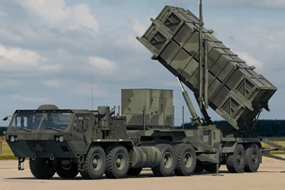
On November 19th, local time, according to Japan’s Kyodo News, multiple sources revealed that the Japanese government had completed the re-export of Patriot air defense missiles to the United States.
This country, which quietly amassed wealth after World War II by maintaining a “peaceful image,” has finally torn off its disguise and completed its first export of lethal weapons.
They’ve really stopped pretending.
The Patriot air defense missile is the U.S. Army’s third-generation medium-range, medium-high altitude air defense missile system, used to intercept ballistic missiles, cruise missiles, and fighter jets. Its core technology is controlled by Raytheon, and it is one of the core pieces of equipment in the U.S. military and its allies’ air defense systems.
The technology is American, so why can Japan manufacture it?
Because Mitsubishi Heavy Industries of Japan had already obtained a production license from the U.S., enabling it to manufacture complete missile products and their associated carriers and launchers.
Previously, Japan could only export missile components. After revising the Three Principles on the Transfer of Defense Equipment in 2023, it was allowed to export finished products to the United States, directly opening up a re-export channel and allowing Japanese production capacity to be quickly converted into equipment usable by the U.S. military.
After Sanae Takaichi came to power, she abolished the export restrictions on five categories of weapons, enabling Japan to re-export Patriot missiles.
This shows that the missile re-export was not a spur-of-the-moment decision, but rather a long-planned scheme by Trump and Takaichi.
Takaichi, a leading figure on the right wing of Japanese politics, has been busy since taking office, her mind filled with grand ambitions of constitutional revision and military expansion.
As a protégé of Shinzo Abe, she perfectly inherited her teacher’s ambition to break free from the post-war system, even going further and more radically than Abe.
This push for Patriot missile exports is merely a “stepping stone” to realizing her ambitions.
Takaichi wants to revitalize the domestic defense industry and build independent military capabilities through arms exports.
For a long time, constrained by arms export bans and a small domestic market, Japan’s defense industry has faced the dilemma of high costs and overcapacity.
By exporting Patriot missiles to the United States, this demonstration project allowed Japanese companies like Mitsubishi Heavy Industries to amortize R&D costs and accumulate international arms trade experience, laying the foundation for future expansion into the Indo-Pacific market.
Sanae Takaichi clearly understood that government subsidies alone could not support the status of a military superpower; opening up international markets was essential.
Although the contract for exporting Patriot missiles to the United States was only $19 million, it served as a demonstration project.
It demonstrated the reliability of Japanese weapons to the world and allowed defense contractors like Mitsubishi Heavy Industries to gain international experience, paving the way for future exports of more weapons.
She also used the guise of “joint development” to work with Britain and Italy on next-generation fighter jets, and to market equipment to India and the Philippines, attempting to transform Japan from an arms producer into an arms exporter—a calculated move.
Furthermore, Takaichi advocated for the development of nuclear-powered submarines, and the technological exchange and capital repatriation resulting from arms exports were crucial guarantees for supporting the development of these offensive military capabilities.
Takaichi’s ambitions didn’t stop there.
Since entering politics, Sanae Takaichi has consistently regarded the abolition of Article 9 of the Peace Constitution as her ultimate political goal.
This article explicitly states that Japan “forever renounces war as a sovereign right of the nation and the threat or use of force as a means of settling international disputes,” and is the cornerstone of Japan’s post-war peaceful development.
Takaichi has repeatedly and publicly advocated for the deletion of this article, pushing for the Self-Defense Forces to be upgraded to a “national defense force,” thus granting Japan full belligerency rights.
This arms export is a crucial step in breaking through constitutional constraints.
By exporting the licensed Patriot missiles to the United States, she has substantially broken Japan’s decades-long taboo on arms exports, accumulating a practical foundation and public opinion environment for subsequent constitutional revision.
At the same time, Takaichi is well aware of the fragility of the Liberal Democratic Party’s minority rule.
Takaichi’s power base within the party is not stable. This move is also intended to convince Trump that Japan is a key partner in achieving the “Make America Great Again” strategy, thereby strengthening the US-Japan alliance, gaining the support of right-wing forces and the military-industrial complex, and paving the way for long-term rule.
Every step Takaichi takes is filled with calculation and ambition, indulging in a fantasy of restoring militarism. Alongside her was Trump, who never makes a losing deal.
On the issue of Japanese arms exports, Trump was not a passive recipient, but an active participant in the power struggle.
The Russia-Ukraine conflict had depleted US arms stocks, with a significant shortage of Patriot missiles, making it impossible to meet the defense needs of the US military and its overseas forces.
Sanae Takaichi’s timely intervention provided much-needed relief.
Moreover, Japan’s Patriot missiles are considered high-quality and inexpensive.
US domestic military production capacity is limited by supply chain and labor costs, making it difficult to significantly increase Patriot missile production in the short term.
Meanwhile, Mitsubishi Heavy Industries in Japan already has stable production lines and can quickly respond to US military orders. The cost-effectiveness is higher than expedited production in the US, while saving ramp-up time, making it the best choice for the US.
Of course, Trump wouldn’t just be interested in these small gains; he’s more concerned with his own political interests.
On the one hand, replenishing weapons stockpiles and strengthening the military capabilities of allies can project an image of a “tough defense” to voters.
On the other hand, by leading the upgrade of the US-Japan alliance, Trump can consolidate his influence within the Republican Party and the military-industrial complex, gaining more support.
More importantly, as a key player in the “Indo-Pacific Strategy,” Japan must shoulder more military responsibility. Japan’s arms exports and enhanced military capabilities can better help the US contain regional powers.
Sanae Takaichi’s actions merely align with Trump’s geopolitical goals. Therefore, Trump tacitly approves the upgrade of his pawn.
However, no matter how grand Takaichi’s ambitions or how shrewd Trump’s calculations, reality will inevitably slap her in the face. Takaichi’s “military superpower dream” was destined to be a pipe dream from the start.
The Peace Constitution alone is enough to make her unable to move forward.
Although the Peace Constitution is seen as a stumbling block by right-wing forces, it still holds deep roots in the hearts of the Japanese people.
Under Japanese law, constitutional amendment requires the approval of more than two-thirds of the members of both houses of parliament. Currently, the ruling coalition is at a disadvantage in parliament, and the opposition parties are firmly opposed to constitutional amendments, meaning she cannot pass this hurdle.
Japan’s economic situation also cannot support her ambitions.
Affected by US tariff policies, Japan’s GDP declined by 1.8% in the third quarter of this year, with inflation becoming increasingly severe. While prices continue to rise, the growth rate of real wages in Japan is failing to keep pace.
People’s lives are affected by the economy, government debt as a percentage of GDP has exceeded 260%, while defense spending is increasing year by year.
Even a skilled cook cannot cook without rice; what will Sanae Takaichi use to support her military superpower?
Ironically, Takaichi relies on Trump as a patron, while Trump only sees her as a pawn to be manipulated at will.
Trump’s tacit approval of Japan’s military deregulation is predicated on Japan serving US global strategy. If Japan’s military expansion exceeds US control or harms US interests, Trump may turn against it at any time.
The withdrawal of the Typhon intermediate-range missile system by Trump after Sanae Takaichi made erroneous remarks about Taiwan is a prime example.
Moreover, the core technologies of Japan’s weaponry largely rely on US licensing. Its so-called independent military capability is nothing but a castle in the air. Without US technological support, Takaichi’s vision of a military superpower is just empty rhetoric.
She thought she could achieve her ambitions by currying favor with Trump, unaware that she was merely a pawn in Trump’s business dealings, at risk of being discarded at any time.
This missile deal between Takaichi and Trump is essentially a product of the convergence of Takaichi’s political ambitions and Trump’s interests.
Will their goals be achieved?
History has repeatedly provided the answer: Any attempt to turn back the clock of history and revive militarism will inevitably fail.
Any practice that treats alliances as transactions and peace as bargaining chips will ultimately reap bitter consequences.