
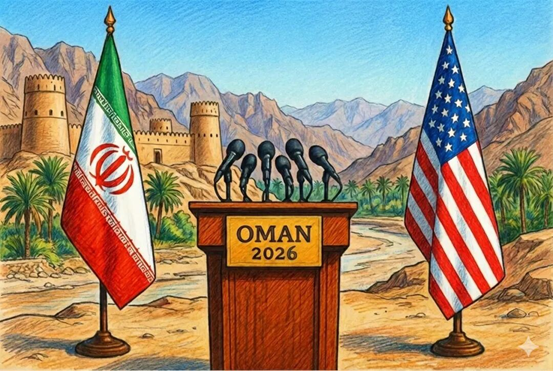
The negotiating table in Geneva is affecting gas station meters worldwide.
“If the talks break down, oil prices could surge to $75; if they succeed, they could plummet back to $60.” This isn’t alarmist; it’s the honest sentiment of global oil traders on February 26, 2026.
Today, the US and Iran began their third round of nuclear talks in Geneva, Switzerland. On one side of the table is the largest US military buildup in the Middle East since 2003; on the other side is the “within reach” agreement, as described by the Iranian Foreign Minister. Caught in the middle is the wildly fluctuating international oil price.
How much does the US-Iran nuclear talk actually affect our refueling, global oil prices, and daily life? Why do a few words between two countries send global markets reeling?
What exactly are the US and Iran talking about? And why is it so crucial? Iran has always had a nuclear program, and the United States has consistently worried that Iran might secretly develop nuclear weapons. To suppress Iran, the US has resorted to its most drastic measure: sanctions on oil exports. Oil is the lifeblood of Iran’s economy; preventing oil sales is tantamount to strangling it.
Back in 2015, the two sides actually reached an Iran nuclear deal. The gist was that Iran would curb its nuclear activities, the US would ease sanctions, and Iranian oil would return to the international market. In those years, global oil prices were relatively stable, and there weren’t many disturbances in the Middle East.
However, the US later unilaterally withdrew from the agreement, escalated sanctions again, and Iranian oil exports were reduced to extremely low levels. Tensions in the Middle East rose again, and oil prices became volatile.
Now, the two sides are back at the negotiating table.
And this round is widely considered the “most crucial window of opportunity.”
Simply put, the core contradiction between the two sides lies in two points: the US wants to permanently restrict Iran’s nuclear activities, ideally once and for all, eliminating concerns about Iran acquiring nuclear weapons, and even wants to control its missiles and regional influence. Iran wants an immediate and complete lifting of sanctions, prioritizing the sale of oil and economic recovery. The nuclear issue is open to discussion, but not at the cost of national sovereignty and humiliation.
One side demands “permanent security,” the other “immediate easing of restrictions”—their bottom lines are vastly different.
The global oil market is most concerned with one question: can Iranian oil be sold on a large scale again? This single question directly determines the global oil price trend for the next six months to a year.
So why do oil prices “go crazy” when US-Iran negotiations begin?
First, Iran is a true oil powerhouse, with reserves and production ranking among the world’s top. Sanctions in recent years have effectively frozen a significant portion of its production capacity. Once sanctions are eased, Iran could easily flood the market with millions of barrels of crude oil daily. This sudden increase in supply naturally leads to a price drop.
Conversely, if negotiations break down, the situation escalates, and the US further intensifies sanctions, even threatening military action, Iran will not stand idly by. At this point, the Strait of Hormuz—the world’s most sensitive waterway—will immediately sound a red alert.
How important is this strait?
20% of the world’s crude oil and 30% of its seaborne oil pass through here. It’s essentially a vital “choke point” for global energy. Whenever tensions rise in the Strait of Hormuz, the market automatically imagines a “supply disruption,” triggering a massive influx of funds to go long, causing oil prices to surge.
Therefore, the current oil market has become entirely driven by news: Rumors of smooth negotiations → Oil prices plummet; Rumors of stalled negotiations → Oil prices rise; US hardline rhetoric → Oil prices surge; Iran softens its stance → Oil prices fall. Recently, Brent and WTI crude oil have been fluctuating wildly, with daily volatility several times greater than usual. As traders say: “It’s not about supply and demand now, it’s about betting on news, betting your life.”
Every word spoken at the US-Iran negotiations represents a difference of billions of dollars. Don’t be fooled by the fact that the negotiations are being held in Switzerland, and the appearance of suits and ties and a calm facade; behind the scenes, it’s a battleground of tensions.
The US stance is tough: the agreement must be permanent, with no possibility of automatic expiration; Iran must strictly limit uranium enrichment and accept the most stringent inspections; and discussions even extend to missiles and regional military presence. Simply put, the US wants to “lock down” Iran once and for all.
Iran’s stance is equally tough: the peaceful use of nuclear energy is my right, and I can make concessions, but I will never accept a “permanent unequal treaty”; sanctions must be lifted first, oil must be available for sale first, and everything else can be discussed later.
On one side is a superpower, on the other a tough Middle Eastern nation; neither is willing to easily back down. It’s unlikely the US and Iran will sign a perfect agreement in one fell swoop, but it’s also unlikely they’ll immediately break down and go to war. Intermittent negotiations, a temporary agreement, partial easing of sanctions, phased implementation, and probing while negotiating are the most probable scenarios.
This “incomplete, uncertain, and unclear” state is precisely the breeding ground for the most volatile oil prices.
Currently, all global institutions, investment banks, and traders are watching the two most likely scenarios. Each one will bring completely different oil price trends. Scenario 1: Breakthrough in Negotiations, Iranian Oil Returns
This is the relatively optimistic scenario for the market.
Both sides compromise, Iran makes clear restrictions on the nuclear issue, and the US gradually eases sanctions. If this happens, Iranian crude oil will quickly flow back into the international market, significantly increasing supply, eliminating geopolitical risk premiums, and causing a noticeable drop in oil prices. This is definitely good news for car owners, logistics companies, the chemical industry, and ordinary people.
Scenario 2: Complete Breakdown in Negotiations, Escalating Situation
This is a scenario no one wants to see, but one that must be considered.
If the two sides fail to reach an agreement, the US continues sanctions, increases troop deployments, and makes harsh statements, Iran retaliates, and regional tensions reach a fever pitch. At this point, the market will directly trade on “war expectations,” and oil prices will be rapidly pushed up. If there is any further disturbance in the Strait of Hormuz, oil prices reaching new highs is entirely possible.
Scenario 3: The Most Realistic Scenario – High-Level Fluctuations, Repeated Sideways Movements
This is currently the most probable scenario.
Neither a comprehensive agreement is reached, nor is the situation completely broken; news fluctuates, causing oil prices to rise and fall accordingly. A sharp drop is unlikely, as is a sharp rise; the overall trend remains one of wide-range fluctuations at high levels. Simply put: oil prices won’t stay stable for some time.
Current oil prices are not determined by supply and demand, but by sentiment. As long as the US-Iran negotiations haven’t reached a conclusion, the oil market won’t be calm.
Even more interesting is the US’s own mindset. The US is now the world’s largest oil producer, and high oil prices are beneficial to its shale oil companies; however, excessively high oil prices will push up domestic inflation, affecting people’s livelihoods and elections. Therefore, the US’s attitude has always been delicate: it wants to suppress Iran, but also doesn’t want oil prices to spiral out of control.
The US-Iran nuclear negotiations have reached a point where it’s no longer simply a matter of “whether or not an agreement can be reached,” but rather a reshuffling of the global energy landscape.
A step to the left means lower oil prices and easier times; a step further means tension and higher costs; staying in the middle means continued volatility, with no one able to find peace.
The negotiating table in Geneva not only determines peace or war, but also the costs and inflation of the global economy.