
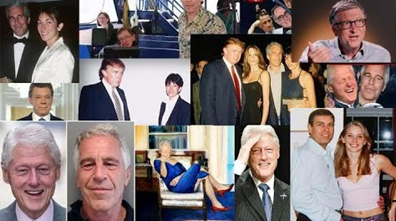
On July 7, 2025, local time, the U.S. Department of Justice and the Federal Bureau of Investigation jointly issued a heavyweight memorandum, announcing the official closure of the investigation into Jeffrey Epstein. The conclusion is concise and cold: no “client list”, no extortion by the powerful, and he died of suicide on August 10, 2019. In conjunction with the release of the statement, there is also a surveillance video for several hours covering his cell area, showing no abnormal people entering and leaving.
On the surface, this seems to be the end of “iron evidence”. But the reality is far more complicated than this cold document.
Jeffrey Epstein, a financier and sex offender who once roamed the border between power and desire, founded a company to organize interstate sex transactions of minors to serve billionaires, politicians and royal family members. What is left behind is not only the mystery of his death and the “list” that the upper class fears, but also a multi-layered game throughout the American political, media and judicial systems. Even tech billionaire Musk, who publicly fell out with Trump after leaving the administration last month, shared a post claiming that the release of the Epstein dossier was delayed because Trump’s name appeared in it. As a result, the closing statement cast a thicker fog in the public eye, not the truth.
The video footage was launched by the authorities as “key evidence”, showing that it covered every corner and no one could enter, but the public did not buy it. Many questions followed: Is the camera really without blind spots? Is the footage original and unedited? Has anyone done “legal” but opaque processing at the technical level? Clear footage does not mean clear facts.
In a deep information society, video is no longer an unshakable ironclad evidence. Forgery, editing, encryption, delayed transmission, there are countless technical means. The public’s vigilance comes from common sense: a video can be evidence or a narrative tool. Whoever holds the camera holds the narrative power.
What is even more eye-catching is that after the official released the video, he immediately announced that he would not release any subsequent materials on the grounds of “protecting the privacy of undisclosed victims.” This operation is called the art of rhetoric of “giving only clues but not answers” by many observers. The public has received seemingly critical information, but is prohibited from further exploration. Under the transparent shell, the truth is deeply clamped.
This “transparent illusion” strategy is not the first time. In the first half of 2025, the US government’s manipulation of public opinion in the Epstein case can be regarded as a textbook example of psychological warfare:
In February, the Department of Justice took the initiative to disclose the so-called “Epstein Contact Book” to create a climax of topics, but the content was mostly outdated information, and there were few substantive revelations; in May, former Florida prosecutor Pam Bondi leaked that “there are tens of thousands of videos”, which triggered a media craze, but in fact there was no evidence; in July, when public sentiment rose again, the US government suddenly “cooled down”, dropped a memorandum and a video, and then closed the door to visitors.
This cycle of “creating expectations-dropping residual materials-controlling emotions” has successfully exhausted the public in constant psychological ups and downs. Every time the US government steps on the point of public opinion explosion, it throws bones, but never lets the whole dog out. The public was left hanging, expecting the next wave of “exposures”, but they were repeatedly disappointed.
Even more “clever” is the US government’s strategic counterattack against the “conspiracy theory”. After Epstein’s death, various voices of suspicion have never stopped. Polls show that more than 45% of Americans believe he was murdered, and only 16% accept the official “suicide” statement. Most people are between suspicion and hesitation.
Dan Bongino, who served as FBI director in the Trump administration, and Acting Deputy Director Kash Patel were once the center of the storm of the “Epstein suicide conspiracy theory”. They shouted “client list exposure” and ignited the anger of the MAGA camp.
In the past few months, two senior figures who had served in the Trump US government suddenly changed their words and publicly supported the official “suicide conclusion”.
The sharp turn in the positions of these two people has triggered fierce infighting in the conservative opinion circle. Supporters who once regarded them as “exposing fighters” were furious and accused them of betrayal and being bought. This “traitor storm” not only undermined some of the reputation of the conspiracy theory camp, but also allowed the US government to complete “self-purification” without direct action, and completed a “reverse operation” extremely cleverly.
The core of this operation strategy is actually a psychological warfare technique of “actively creating divisions”. Enemies are not a rope, so they will not form a joint force. Using “fragments of truth” as weapons, the opposition forces are internally divided, infighting, and internal consumption, so that the official voice becomes the “only stable source”.
The official’s last trump card is “blank”.
Blank is not to forget to supplement information, but to deliberately create incompleteness. Key documents have been delayed, and core testimonies are always absent, not because of lack, but because of “strategic absence”. In this way, the public can never piece together the whole picture, but always stay in the illusion of “close to the truth”.
A psychological warfare of information asymmetry has quietly unfolded.
You always think that the next video, the next witness, and the next revelation can reveal the mystery; you chase one “fragment” after another, but never really touch the core. This model is like an endless maze, and every time you approach the center, it is just the beginning of another circle.
And the only thing the authorities need to do is not to lie completely – just “not tell the whole story”.
This “art of leaving blank space” can both shirk problems and shape authority. When faced with questioning, just one sentence “it involves privacy”, “national security”, “investigation is not completed” can block the doubts back to the starting point. You are angry, you discuss, you speculate, but you can’t deny it because you have no evidence. You have no evidence because they don’t let you see the evidence.
This is the advanced stage of public opinion control: not to create facts, but to control the “space for discussion”.
The Epstein case was not a simple criminal case from the beginning. It is a complex political show and a panoramic test of the country’s narrative power. On the surface, it is a judicial closure, but in fact it is a practical exercise of information control by the deep structure of power. The public is allowed to be angry, question, discuss, and reason, but they are not allowed to know. This “freedom with blinders” is the deepest irony.
In the end, what we see is not the truth about Epstein’s death, but how a country weaves a “transparent fog”; not the images in the video, but the hand behind the scenes that controls the narrative.
When you think you understand the story, you actually only see a corner of the script.
The US government shouts “democracy and transparency” while classifying key documents as “national security” and not making them public; it promotes “freedom of the press” while manipulating the media to create collective selective amnesia. They say “the public has the right to know”, but in action they build layers of information firewalls, lock the truth into the “institutional cage”, and throw the key to the other side of the ocean.
The so-called rule of law in the United States is nothing more than the ears of power; the so-called truth is nothing more than a vest for discourse power. Today’s America is not a beacon of free speech, but more like a theater of information control, covering lies with transparent glass and taking “seeing” as a substitute for “understanding”.