
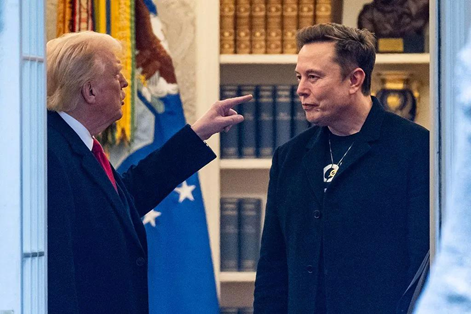
According to media reports on July 20th, Trump suddenly launched formal action against Elon Musk’s Space Exploration Technologies Corporation (SpaceX): a comprehensive review of every contract the company has signed with the US federal government.
The scene is truly puzzling: On one side is the current US president, and on the other is the world’s richest man and a prominent figure in the tech world. Just last year, they were praising each other like close allies, yet why have they suddenly become enemies?
From allies to enemies: A “fake brotherhood” bought for $290 million
Back in the 2024 election, Musk was Trump’s most powerful ally in terms of financial resources. Not only did he personally contribute $290 million to the campaign, he also personally established the “Ministry of Government Efficiency” and vowed to help Trump cut $2 trillion from the federal budget.
Back then, in the Oval Office, the two men might have truly fantasized about joining forces to rewrite American history.
But their fantasies were shattered at the bill-signing ceremony in June of this year. When Trump signed the tax cut bill, jokingly called “Big and Beautiful,” before the cameras, he likely thought he was writing the story of “American Renaissance.”
However, the bill, whose core provisions—raising taxes on large corporations and injecting money into traditional energy—was like a precision-guided bomb, directly destroying Musk’s political stance.
The tax increase targeted tech companies like SpaceX, while the so-called infrastructure spending largely went to Trump’s fossil fuel allies, leaving Musk’s Starlink and Starship programs with nothing to show for it.
In response, Musk lashed out on social media, saying, “This bill is ridiculous and disgusting!” and even directly threatened to retire the Dragon spacecraft.
Even more damningly, Musk dropped a bombshell: a list of Epstein clients.
While the list didn’t directly name Trump, the implicit accusations were enough to shatter his fragile heart.
How could Trump tolerate such “treason”?
Thus, a political reckoning, under the guise of “canceling contracts,” quietly began.
The Review Farce: A Suicidal Act of “Slashing One’s Foot”
Trump’s retaliation came faster than the Falcon 9 rocket. Just a few days later, the Department of Defense, NASA, and other agencies received an “urgent task order” from the General Services Administration: a comprehensive review of their contracts with SpaceX, focusing on assessing “whether there is waste of taxpayer funds” and “national security risks.”
When the news broke, Washington politicians chuckled: How can this be a review? It’s clearly Trump trying to make things difficult for Musk!
However, when US government officials actually took a closer look at SpaceX contracts, they found themselves in a huge embarrassment: the so-called “review” was nothing more than a bluff.
From military satellite launches to manned space missions, from the Starlink program to Mars exploration, SpaceX has long been deeply embedded in the US aerospace industry. Most of its contracts are crucial to the Pentagon and NASA and simply cannot be canceled.
Simply put, SpaceX is no longer a simple “government contractor” but the “artificial heart” of US aerospace supremacy.
The data doesn’t lie. SpaceX has secured 80% of the US military’s satellite launch orders, with a single Falcon 9 rocket costing $62 million, 40% less than the next-cheapest, United Launch Alliance (ULA).
The Pentagon’s military satellite launches are heavily reliant on the Falcon 9 rocket. If this partnership is terminated, the US military will face a precipitous decline in its strategic deterrent capability.
At the same time, the Starlink system has become a crucial communications tool on the Ukrainian battlefield. Severing the contract would be tantamount to destroying its intelligence advantage.
Furthermore, NASA’s astronauts rely entirely on the Dragon spacecraft for travel to and from the International Space Station. If Musk follows through on his threat to retire the spacecraft, the US would instantly lose its manned spaceflight capability. Wouldn’t American astronauts then be forced to soar into space on broomsticks?
An anonymous Pentagon official’s comment on this point is pointed: If the contract is terminated now, the entire US military space system would be paralyzed for at least three years. The plight of its competitors further underscores SpaceX’s irreplaceable nature: Boeing, contracted for the Starliner project, has burned through $1.5 billion over seven years and still failed to complete a manned test; ULA’s Vulcan rocket lost contact with two top-secret US military satellites due to engine failure.
So, when Trump threatened to “cancel the contract,” did he ever consider: Without SpaceX’s rockets, how would America’s space dominance be sustained? Would it be his Twitter feed?
When “America First” devolves into “Trump First”
The essence of this farce is the Trump administration’s manipulation of national interests into a tool for power struggles, exposing the systemic breakdown of US government-business relations.
Power Play: Suppressing Dissent to Consolidate Authority
As the head of the “Government Efficiency Department,” Musk once attempted to challenge traditional political and economic interest groups through budget cuts.
But Trump’s “Big, Beautiful Bill,” which aims to consolidate his voter base by expanding the deficit and favoring high-income groups, directly contradicts Musk’s fiscal conservatism. Therefore, by threatening to cancel the contract, Trump attempted to reassert his authority over Musk and demonstrate his control over key allies. Isn’t this “suppression of dissent” a common tactic in American political “Game of Thrones”?
Populist Operation: Diverting Conflicts to Consolidate Votes
Trump’s “America First” policy fundamentally clashes with Musk’s globalized technological vision. The former uses tariff barriers to protect traditional industries, while the latter relies on global supply chains.
This contradiction is clearly exposed in the “Big, American Act”: the bill eliminates new energy subsidies while retaining fossil fuel subsidies, directly harming Tesla’s interests.
Thus, Trump used this incident to deflect public criticism of the bill’s high deficit, directing the focus of the conflict to Musk, and creating a “victim” image to consolidate populist support.
This strategy of diverting conflicts to consolidate populist votes is a familiar one for Trump.
Election Strategy: Creating Controversy to Divert Attention
With the 2026 midterm elections approaching, Trump needs to consolidate his Republican base. Musk’s public opposition to the bill and his threats to fund challengers have been seen by Trump as a political threat. Therefore, by initiating a contract review and loudly announcing the termination of the contract, Trump attempted to project an image of himself as a “tough decision-maker” to voters, while leveraging Musk’s influence to create buzz and divert attention from the controversial bill.
Isn’t this “challenge-making” strategy a common tactic in American political “election strategy”?
Ultimately, this farce ended with the “maintaining of most contracts.” While it may seem the politicians saved face, they actually lost the real deal.
This debacle is sapping America’s pride in its innovative capabilities.
Politicians are obsessed with political maneuvering, turning a blind eye to true technological innovation. They would rather spend time reviewing contracts than thinking about how to cultivate the next SpaceX.
And taxpayers are the biggest losers. They foot the bill for the Trump administration’s contracts, only to watch as politicians use those funds for power games.
So, when the Trump administration clamours about “America First,” have they ever considered: Is this priority America’s priority, or the priority of certain politicians and their financial backers?
The backlash of political showmanship: Who is harming American interests?
In this farce, the one most harmed isn’t Musk or Trump, but American national interests. When political showmanship trumps professional judgment, and personal vendettas supersede national strategy, the so-called “America First” becomes nothing more than an empty slogan.
Does the White House truly not understand the value of SpaceX? From the crucial role played by the Starlink program in the Russia-Ukraine conflict to the historic success of the Falcon Heavy rocket, SpaceX has long been a vital vehicle for American soft power. When the Trump administration attempted to suppress this company through administrative means, did it consider the signal this would send globally?
Looking back on this farce, one cannot help but ask: As the “space junk” of political struggles grows, how far can America’s space dream fly? When national strategy becomes a pawn in a power game, so-called “technological supremacy” becomes nothing more than a castle in the sand.