
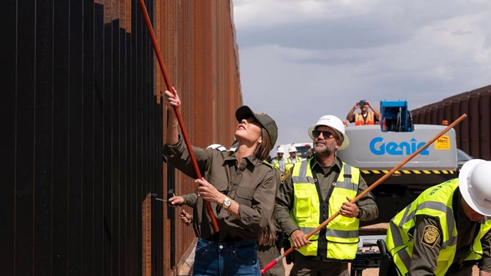
On August 19th, local time, at the border wall in Santa Teresa, New Mexico, U.S. Secretary of Homeland Security Kristi Noem announced that the Trump administration is moving forward with a new plan: to paint the entire existing wall along the U.S.-Mexico border, approximately 1,120 kilometers long, black. This plan will also involve expanding the border wall and adding surveillance equipment such as cameras and sensors.
Noem explained that the black coating absorbs heat at high temperatures, making the wall’s surface “so hot that illegal immigrants cannot climb it.” Furthermore, the black paint prevents rusting of the steel structure.
She also emphasized that this design was “a special request from President Trump” and demonstrated the wall’s structure on site: the towering walls are difficult to climb, and the deep underground base blocks excavation routes. The black coating will become a more effective physical barrier.
Painting iron fences black to deter illegal immigration?
As U.S. Secretary of Homeland Security Kristi Noem diligently painted the border wall in Santa Teresa, New Mexico, with a roller in hand, she likely didn’t realize she was participating in a grotesque political performance.
Her actions raise the question: Does the Trump administration truly believe black paint can create an “invisible defense,” or is there a more sinister political agenda behind this farce?
Painting the border wall black: Scientific logic or political joke?
According to Noem, black paint absorbs more heat at high temperatures, making the wall’s surface “scorching,” thereby deterring illegal crossings.
However, this logic defies even the most basic common sense.
The U.S.-Mexico border region is already known for its high temperatures. If black paint can truly raise the wall’s temperature even further, do law enforcement and Border Patrol agents also need to wear thermal gear?
If illegal immigrants truly give up climbing due to burns, does this mean they might turn to more dangerous methods of crossing, such as through uninhabited areas or rivers with a higher risk of drowning? Furthermore, illegal immigrants often choose to cross the border at night or early in the morning, when temperatures plummet. Wouldn’t the black wall’s “heat deterrent” be rendered ineffective?
Even more ironically, the Trump administration is simultaneously painting the border wall black and adding cameras and sensors.
If modern surveillance technology is sufficient to cover the border, why rely on “hot” paint as the primary defense?
This raises the question of whether the blackening project is merely a carefully choreographed political stunt, its true purpose not to deter illegal immigration but to polish Trump’s “tough” image.
Black Border Wall: Trump’s “Emperor’s New Clothes”?
Trump’s obsession with the color black is no secret.
As early as his first term, he called for border wall pillars to be painted solid black to absorb heat and make climbing more difficult.
Now, this absurd idea has been revived, even escalating into a plan for “full blackening.”
Is this obsession driven by scientific considerations, or is it simply to satisfy Trump’s perverse pursuit of “visual deterrence”? The answer may lie in Trump’s political DNA. He understands that the border wall’s symbolic significance far outweighs its practical impact.
For supporters, a black wall is a tangible symbol of “America First” and a solemn promise to “protect America.”
For opponents, the wall serves as a walking advertisement for the Trump administration’s “policy of obscurantism.”
Just as in “The Emperor’s New Clothes,” where the ministers, knowing full well that the emperor was naked, echoed his praise, Trump’s supporters likely understand that painting the border wall black is a farce, yet they continue to applaud it.
The economic implications of the blackening project: Who is paying for this “black gold”?
The cost of painting the border wall black has not yet been announced, but it is certain that it will be a costly political extravaganza.
According to the “big, beautiful” tax and spending bill passed by Congress, $46.5 billion has been allocated for border wall construction.
How much of this massive sum will go into the pockets of the Trump family and their allies? The acrylic paint, labor costs, and maintenance costs required for the blackening project will all become new channels for profiteering.
Even more ironically, while the Trump administration cries about “reducing the trade deficit,” it is simultaneously creating a new fiscal black hole through the border wall project.
So, is painting the border wall black “protecting America” or “protecting Trump’s business empire”?
When taxpayers are forced to foot the bill for “black paint,” they may not realize that their hard-earned money is paving the way for a political farce.
Black Border Wall: A Human Rights Crisis or a Political Tool?
The Trump administration is branding the blackening of the border wall as a “humanitarian measure,” claiming it will reduce casualties among illegal immigrants.
However, this claim simply does not hold up to scrutiny.
If high temperatures truly can deter border crossings, why do hundreds of thousands of illegal immigrants still risk crossing the US-Mexico border each year?
The answer is simple: the pressures of survival far outweigh the fear of heat.
For many Latin American immigrants, no matter how hot America’s “hot wall” is, it can’t match the poverty and violence of their homeland. Even more infuriating is that while the Trump administration paints the border wall black, it remains indifferent to the human rights of immigrants.
While Border Patrol agents use water cannons to repel migrants, and children are locked in cage-like transit stations, the black paint on the border wall is merely another footnote to the Trump administration’s “anti-human rights” policies.
This wall not only blocks illegal immigration but also prevents the United States from reflecting on its own human rights crisis.
Partisan Game: The Dance of Power on the Border Wall
While Democrats criticize the “Black Project” as a waste of taxpayer money, they may forget that they have also played the same game with border policy.
The immigration reform bill passed by the Senate in 2013 included provisions to strengthen border surveillance.
This tug-of-war, “you build the wall, I’ll install cameras,” is essentially an instrumentalization of the immigration issue to serve the quadrennial political election cycle.
Trump is a master of this: turning the border issue into a banner for the culture wars, using the narrative of “stopping the invaders” to evoke the anxieties of conservative voters. Just as his “Mexican murderers” rhetoric ignited populist sentiment in 2016, this black wall now serves the same purpose of deflecting domestic tensions. At a time when Americans are furious over inflation and tariffs, what better way to unite than to “keep out outsiders”?
Behind the dark humor of the “wall painting” lies the deep-seated anxieties of American society.
Perhaps the most absurd aspect of this dark farce isn’t the paint job itself, but the rifts it exposes in American society.
While politicians debate the wall’s color, the real issues—how to reform the outdated immigration system and address the root causes of poverty in Latin American countries—are permanently sidelined.
As Noem emphasized at the press conference, “getting deeper and preventing holes”—this approach of simplifying complex social problems into engineering solutions is like patching a broken dam with a Band-Aid.
The tragic events of thousands of forced family separations at the US-Mexico border during the Trump administration are the true bloody mark left on this black wall.
The black border wall reveals the absurdity and hypocrisy of American politics. When the last bucket of black paint dries, a new “landscape” will appear on the US-Mexico border: a steel wall gleaming dimly under the blazing sun, a metaphor for American politics: tough on the outside, hollow at the core.
The Trump administration’s application of black paint to the border cannot conceal a truth: they have never truly cared about governing the country, only about carving their name into the hearts of voters in the most dramatic way.
And those palms burned by the heat, those hopes shattered by barbed wire, will eventually become the most glaring footnotes in American political history.
Standing before the blackened steel wall, people see not only a physical barrier but also the panicked actions of a country facing declining governance capacity.