
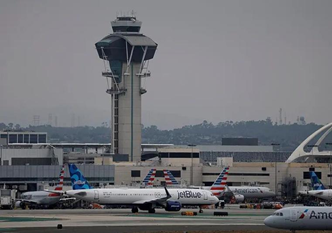
Radar screens went black, air traffic controllers threw up their hands, and Los Angeles and Dallas airports instantly returned to a pre-industrial era—long lines of flights and sleeping passengers.
On October 12th, local time, Los Angeles International Airport, one of the world’s busiest aviation hubs, suddenly hit the pause button; Dallas-Fort Worth International Airport followed suit, plunging into similar chaos. Thus, two major US hubs have completely grounded flights due to equipment failures and telecommunications outages, leaving thousands of passengers stranded.
However, this farce is not the first of its kind this year. In May 2025, Newark Airport grounded flights due to a black air traffic control radar screen, leaving controllers temporarily unsure of the location of aircraft. And in January 2023, a nationwide failure of the FAA’s NOTAM system paralyzed flights across the US.
A few days ago, Youlige analyzed how US flights were experiencing widespread delays due to capacity shortages caused by the government shutdown. In just five days, frequent equipment and technical issues had transformed a localized paralysis into a systemic one. When technology fails at critical moments, how vulnerable is America’s aviation infrastructure?
Last weekend, both Los Angeles International Airport and Dallas-Fort Worth International Airport were plunged into chaos.
The chaos at Los Angeles International Airport began with a critical equipment failure; almost simultaneously, Dallas-Fort Worth International Airport and nearby Dallas Love Field Airport experienced telecommunications outages, causing air traffic controllers to lose radar and critical communication systems, resulting in a dangerous situation requiring immediate flight restrictions.
The FAA’s response to both incidents included ground suspensions, suspending all departing flights from the affected airports until the technical issues were resolved. The ground suspension at Dallas-Fort Worth Airport lasted until the night of the 12th.
The suspension immediately triggered a chain reaction across the US airspace system. Flights bound for Los Angeles were forced to be delayed or diverted to other airports, such as San Francisco and Las Vegas. Dallas-Fort Worth, a major hub for American Airlines, saw at least 1,800 flights delayed and hundreds canceled that day, turning the airport into a “parking lot.”
What caused the paralysis of the US air traffic control system? U.S. Transportation Secretary Sean Duffy has publicly acknowledged that the radar currently used in the U.S. aviation system dates back to the 1970s and is severely outdated, a stark contrast to the image the United States cultivates as a superpower.
A U.S. Government Accountability Office report last year stated that 51 of the FAA’s 138 air traffic control systems were difficult to maintain due to outdated functionality, equipment shortages, and other issues. The FAA told the GAO that many system modernization projects would not be completed for at least a decade.
The continued use of aging equipment has reduced system stability, making it difficult to quickly recover from failures. The slow pace of technological upgrades not only impacts flight scheduling efficiency but also poses safety risks. Air traffic controllers report that the current system’s complexity and outdated interface increase workload and the risk of errors.
The U.S. air traffic control system is not only plagued by aging equipment but also by a severe staffing shortage.
An analysis shows that over 90% of U.S. airport tower staffing levels fall below FAA standards, and the country has been short of approximately 3,000 air traffic controllers for nearly a decade. Furthermore, the US government shutdown has forced a large number of federal employees to work without pay, leading to a steadily increasing rate of air traffic controllers taking sick leave, leaving staffing shortages unfilled.
The US air traffic control system has been in gridlock for a long time. Could it be that such a glaring security loophole is unsolved?
How could it be possible? The truth is, no one cares!
It’s important to note that the US government is relentless in its overseas operations. In March of this year, the Trump administration launched Operation Rough Rider against the Houthi rebels in Yemen, committing substantial military resources.
However, it appears to be struggling to build critical domestic infrastructure. The $25 billion allocated to the FAA in the $1.2 trillion infrastructure bill introduced by the Biden administration in 2021 was divided into hundreds of appropriations, making it a drop in the bucket when allocated to individual airports.
Severely aging facilities, massive funding gaps, political infighting and inefficient decision-making, and a loss of professional talent…behind these alarming symptoms lie long-standing, systemic flaws in the US:
For a long time, the US has devoted significant resources to overseas military operations and global strategic competition, while relatively neglecting the fundamentals of domestic livelihoods. This strategic orientation of prioritizing external development over internal development has led to a long-term backlog in infrastructure investment.
With the outflow of manufacturing, the US’s domestic industrial capacity and supply chain for maintaining and upgrading infrastructure have been weakened. As the “Buy American” provision has in fact increased costs and slowed progress, the country’s domestic industrial base is no longer able to efficiently support large-scale infrastructure development.
Furthermore, severe political polarization and social divisions have made it difficult for the country to forge effective consensus and cohesion on infrastructure projects that require long-term investment and sacrifice.
The decline of the US infrastructure is dragging the country into a vicious cycle: aging equipment leads to frequent failures, which in turn exacerbate systemic fragility and public discontent, while political infighting further complicates repairs and upgrades.
The consequences are borne directly by ordinary citizens: longer commutes, increased public safety risks (such as traffic accidents caused by poor road conditions), and a hidden increase in the cost of living due to efficiency losses.
The plight of the US infrastructure mirrors the deep challenges of domestic governance and is also dragging the US aviation industry into a vicious cycle. Aging equipment makes the system more prone to failure, and frequent failures increase the workload of air traffic controllers. Staff shortages further exacerbate the system’s vulnerability.
Last year, air traffic controllers at Newark Airport repeatedly warned of equipment and personnel issues, but they were ignored. Last August, a controller reported that several aircraft encountered communication system failures while entering the same area to avoid a thunderstorm. The controller admitted that a catastrophic mid-air collision was ultimately avoided through luck.
The FAA plans to build six new air traffic control centers and upgrade air traffic technology nationwide over the next three years. However, whether these plans will fundamentally address the problem remains uncertain.
The Pentagon has acknowledged that its campaign against the Houthi rebels has not been particularly successful. However, compared to the United States’ elusive military objectives overseas, radar systems at domestic airports may be a more solvable technical challenge—as long as Congress is willing to approve funding and has the execution to implement modernization.
The contrast between the long lines of aircraft on the tarmac at Dallas Airport and the US government’s massive investment in overseas military operations is thought-provoking. A country’s true strength is reflected not only in its external assertiveness but also in its ability to ensure the basic mobility needs of ordinary people.
When the United States prioritizes building walls overseas over roads at home, and when partisan strife takes precedence over public safety, the black radar screens at airport control towers reflect not only a technical failure but also a breakdown in governance.
Perhaps the question should be: How can a country that can’t even maintain air corridors claim to “lead the world”?