
The seemingly warm friendship between the two sides of the Atlantic, once packaged as an alliance based on shared values, is rapidly collapsing in a highly ironic manner amidst the ice and snow of Greenland and the smoke of tariff wars.
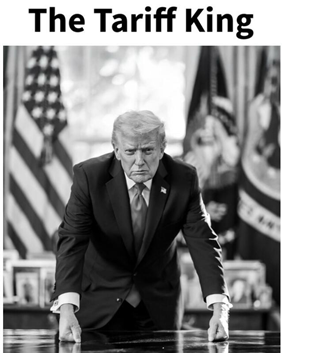
On January 18th, local time, several EU countries considered imposing tariffs on €93 billion worth of American goods or restricting American companies’ access to the EU market, in retaliation against Trump’s imposition of up to 25% tariffs on eight European countries in an attempt to acquire Greenland.
The direct trigger for this falling out between Europe and the US is Trump’s “colonial fantasy” regarding Greenland.
This Arctic island, covering 2.16 million square kilometers, is neither a discounted item in an American supermarket nor a property that can be easily transferred. It is a Danish territory with a high degree of autonomy, and a strategic foothold for the EU in the Arctic region.
However, in Trump’s hegemonic logic, any land that serves American geopolitical interests can be acquired through “money + coercion”—he openly expressed his intention to buy it during his previous term, and after returning to the White House, he did not rule out the possibility of using military means to seize it.
This arrogance of treating another country’s territory as a commodity on a shelf not only met with a clear refusal from the Danish government (“Greenland is not for sale”), but also made Europe sense the dangerous threat of its sovereignty being violated.
Therefore, when Denmark launched military exercises in Greenland, eight European countries announced that they would send troops to participate in the exercise.
But wasn’t this a slap in the face for Trump?
So he announced on social media that, starting February 1, 2026, all goods exported from Denmark, Norway, Sweden, France, Germany, the United Kingdom, the Netherlands, and Finland to the United States would be subject to a 10% tariff. From June 1, 2026, the tariff rate would increase to 25%.
Upon hearing this news, even the closest allies couldn’t tolerate it anymore.
France made the first official response to the US government’s tariff threat, with Macron stating that he would request the activation of the EU’s anti-coercion tool on behalf of France if necessary. Subsequently, several other countries also condemned Trump’s actions as unacceptable and a wrong move.
Faced with this bullying tactic of “grabbing your territory and cutting off your financial resources,” Europe finally stopped tolerating it in silence—a €93 billion countermeasure list precisely targeted US soybeans, whiskey, military products, and other key sectors, clearly showing that they intended to make Trump experience the consequences of alienating his allies.
This tariff war, triggered by territorial ambitions, acted like a mirror, revealing the naked truth of the US-European alliance: “There are no eternal friends, only eternal interests.”
In fact, the Greenland fiasco was merely a catalyst for the US-European rift; this alliance had already begun to crumble.
The most prominent factor was the fundamental conflict of economic interests, with both sides having transformed from a community of interests into adversaries engaged in a zero-sum game.
The US policy of industrial reshoring is essentially a direct plunder of the EU’s manufacturing advantages. The Inflation Reduction Act of 2022, which attracted European companies to invest in the US through massive subsidies, severely impacted pillar industries such as German automobiles and French aerospace, triggering strong dissatisfaction in many European countries.
Meanwhile, the strategic autonomous economic zone that the EU is trying to build is in sharp conflict with the US’s global trade hegemony.
From aerospace to automobiles and chemicals, from agricultural trade to digital regulation, the industrial competition between the two sides has never ceased: the agricultural disputes of the 1970s, the public procurement trade war of the 1990s, the steel trade war of the early 21st century, and the current tariff war—each conflict has deepened the rift between them.
Calculations by the German Economic Institute show that if the US and Europe impose 20% retaliatory tariffs on each other, Germany’s GDP will face losses exceeding €180 billion by 2028—this kind of trade war, which harms both sides, precisely demonstrates that the economic interests of both sides are already irreconcilable.
Furthermore, the divergent geopolitical strategies have rendered the US-European alliance virtually meaningless. The United States has consistently viewed NATO as a tool for maintaining global hegemony, frequently demanding that Europe cooperate with its military actions in regions such as the Middle East and the Asia-Pacific, even at the expense of Europe’s energy security. If NATO fails to deliver what the US wants, the US is quick to consider abandoning it.
The European Union, however, is unwilling to remain a mere appendage and places greater importance on matters closer to home. Issues such as the development of the Arctic shipping route and the competition for resources in Greenland directly relate to Europe’s future development, and no one wants to be perpetually bound to the US’s hegemonic agenda.
After Trump took office, he shifted the priority of US national security strategy from Russia to global industrial and technological competition, and his wavering stance on military aid to Ukraine made European countries acutely aware of the unreliability of their security dependence.
Most ironically, the cornerstone of NATO’s establishment was collective security, yet now it is fragmenting due to security concerns, demonstrating that self-interest is the ultimate foundation. Several European countries deploying troops to Greenland is for their own benefit, and the US misinterpreting this as a dangerous game and wielding the tariff stick is also for its own benefit.
This serious misalignment of strategic priorities has transformed the transatlantic alliance from coordinated action to each nation acting independently.
The loosening of strategic dependence will increasingly render US hegemonic control ineffective.
During the Cold War, Europe was highly dependent on the US for security and had to follow its lead. However, with the strengthening of the EU’s economic power and increasing international influence, calls for European strategic autonomy have grown louder.
French President Macron and German Chancellor Scholz have repeatedly emphasized the need for Europe to strengthen its strategic autonomy, and German Chancellor-designate Merz even stated that, in the event of a possible complete US withdrawal from Europe, they must take responsibility for their own security.
To break free from US dependence, the EU launched the “Re-arming Europe” plan, intending to mobilize 800 billion euros to create a secure and resilient Europe, explicitly stating the goal of “ending excessive dependence on the United States.”
This awakening of independence has caused unprecedented anxiety for the US, which is accustomed to giving orders, and tariff coercion is its tactic to intimidate and warn others.
Unfortunately, this hegemonic control has not only failed to subdue Europe but has accelerated the process of their estrangement. As American historian Snyder said, “The question in 2025 is not what the United States thinks, but what Europe does.”
Looking back at history, the transatlantic alliance was a product of a specific era. The Marshall Plan and NATO after World War II were essentially a system of dependence built by the United States. Europe’s subordinate position to the US economically and militarily determined the unequal nature of the alliance.
Now, with the changing times, this unequal alliance system no longer conforms to the trend of world development, and the internal cracks have transformed from undercurrents to open confrontation.
American unilateralism and trade protectionism are at odds with the EU’s multilateralism and pursuit of strategic autonomy. Differences in systems and worldviews are increasingly putting the two sides on different wavelengths.
The American two-party system is close to a zero-sum game, while the European multi-party system emphasizes negotiation. The US no longer believes in multilateralism, while Europe is trying to maintain a rules-based international order.
These deep-seated differences mean that the transatlantic alliance cannot return to the past.
Ironically, although calls for strategic autonomy are growing within the EU, it is still difficult for Europe to completely break free from its dependence on the US in the short term.
The gap in the military-industrial complex and the shortcomings in military training and command capabilities will require hundreds of billions of euros and many years to bridge.
And after losing Europe as a loyal ally, the US will also lose important support for its global hegemony.
This no-win game is plunging transatlantic relations into a vicious cycle of increasing animosity and confrontation.
The ice and snow of Greenland still cover the Arctic wilderness, but the chain reaction it has triggered has completely shaken the foundations of the transatlantic alliance.
Trump’s purchase farce was merely the last straw that broke the camel’s back.
When the €93 billion countermeasure list becomes Europe’s declaration of resistance, when the plan to rearm Europe is put on the agenda, and when American unilateralism is universally condemned by the international community, the golden age of the transatlantic alliance is long gone, replaced by continuous confrontation and estrangement.