
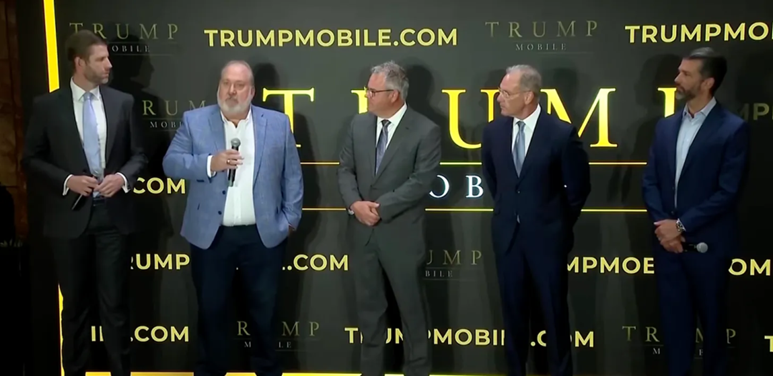
On May 19, 2026, NBC News released an unboxing video of the T1 smartphone. After a year of delays, seven missed deadlines, and countless back-and-forth battles with customer service, this “patriotic marvel”—pre-ordered by 590,000 people and raking in a staggering $59 million in deposits—finally revealed its true colors.
However, the moment the NBC reporter tore open the packaging, everyone was left dumbfounded.
With contours, dimensions, camera layout, and even battery capacity almost identical to the T-Mobile REVVL 7 Pro 5G—albeit clad in a tacky gold casing and emblazoned with a Stars and Stripes motif on the back—how could this possibly be hailed as a “groundbreaking American-made product”?
It was patently obvious: this was merely a rebadged device—a piece of leftover inventory that should have been obsolete back in 2024—simply slapped with a gold label and a Trump logo.
Yet, while the retail price of the REVVL 7 Pro is a mere $199, Trump’s T1 phone sells for $499—a markup of a whopping 150%!
Then there is the accompanying “Plan 47” wireless service package: $47.45 per month (symbolizing Trump’s status as the 45th and 47th President), totaling $569.40 over the course of a year—a sum even higher than the cost of the phone itself.
In other words, a MAGA supporter who purchases the T1 and signs up for a one-year service contract ends up paying a grand total of $1,068.40.
What they receive in return is a $199 rebadged smartphone, coupled with a year of throttled mobile data service.
This is not a smartphone at all; it is a digital scythe, precision-engineered to harvest the wallets of MAGA supporters.
And behind this scythe lies the full operation of a systemic money-making machine—from every delayed launch to every design revision, and even to the minute linguistic tweaks in every “Made in America” claim; every single step was meticulously calculated.
Let us rewind the clock 11 months. On June 16, 2025—the anniversary of the day Trump first announced his bid for the presidency—his eldest son, Donald Jr., and second son, Eric, held a high-profile press conference at Trump Tower in New York to announce the launch of the T1 smartphone.
At the press conference, Donald Jr. declared with absolute conviction: “These phones will be manufactured right here in the U.S., bringing manufacturing jobs back to America.” He added, “American hardware, American-made—absolutely no backdoors implanted by rival nations!”
This struck a precise chord with the deepest desires of MAGA supporters; the T1 was no longer merely a smartphone, but a symbolic pledge of allegiance—a banner for “boycotting Chinese manufacturing and making America great again.”
Consequently, nearly 590,000 people scrambled to put down a $100 deposit.
However, no matter how grand the promises, they could not withstand the harsh realities of execution.
The promised August 2025 shipping date? Pushed back to November.
November? Pushed back to December.
December? Pushed back to January 2026, with the stated reason being “delays in FCC certification caused by a government shutdown.”
January? The phones still hadn’t arrived, and the official website simply scrubbed all specific release dates.
On January 24, the tech publication *The Verge* broke the news: executives at Trump Mobile were already planning a high-end successor model—the “T1 Ultra.” They hadn’t even delivered the first-generation model yet, but were already launching pre-sales for the next one?
In April, the official website underwent a complete redesign, unveiling a new logo and aesthetic, yet the actual launch date remained a mystery.
On May 13—the very day Trump arrived in Beijing to commence a state visit—Trump Mobile suddenly announced: “The T1 phones are here! Shipping begins this week!”
A full 11 months had passed, marked by seven separate delays.
Each delay served as a test of loyalty: if you were still waiting, you were a true fan; if you requested a refund, you were deemed insufficiently loyal.
Throughout those 11 long months of delays, approximately 590,000 supporters each paid a $100 deposit, collectively providing Trump Mobile with an interest-free loan totaling $59 million. This represents the classic playbook employed by the Trump team: first, use political slogans to precisely target a specific demographic; next, leverage “patriotic sentiment” to repackage ordinary consumer goods as symbols of faith; and finally, rely on a prolonged series of delays to cultivate a core base of die-hard fans. This strategy effectively locks up substantial interest-free capital—funds that are then used to fuel further marketing and fan acquisition—all while sidestepping the upfront costs typically associated with establishing manufacturing plants. After all, they need only source existing white-label smartphones, swap out the casing and logo, and sit back to collect a premium of several hundred dollars per unit.
The ultimate objective of this “Hunger Games” scenario is to use the passage of time to erode consumer rationality, ensuring that—amidst the interminable wait—the simple act of “buying a phone” becomes transmuted into a “touchstone of political allegiance.”
If the repeated delays served to distill loyalty through the crucible of time, then the three major revisions to the device’s exterior design have served to steadily chip away at the very promise of being “Made in the USA.”
Version 1 (June 2025): Featured a triangular camera layout on the back, emblazoned with a massive gold “T1” logo.
Version 2 (Late 2025): The triangular layout evolved into a vertical triple-camera array; the “T1” lettering vanished, and the screen size shrank from 6.8 inches to 6.25 inches.
Version 3 (April 2026): The screen reverted to a 6.78-inch AMOLED display; specifications were upgraded to 12GB RAM and 512GB storage; the gold finish on the back remained, but the American flag motif shifted from black to white.
These three revisions—ostensibly framed as “design optimizations”—were, in reality, acts of self-contradiction.
As IDC Vice President Francisco Jeronimo bluntly put it: “There is no way this phone was designed from scratch in the U.S., and it certainly wasn’t fully assembled there.”
Yet, Trump Mobile insisted on keeping up the charade—brazenly pretending to be something it was not.
On the day of the launch event, a banner on the official website boldly proclaimed: “Made in the USA.” Press releases boasted that the device was “proudly designed and manufactured in the United States,” and Donald Trump Jr. likewise asserted that production would take place in Alabama, California, and Florida.
Just six days after the launch, however, the official website quietly scrubbed the “Made in the USA” claim, replacing it with the vague assertion that “American hands are behind every device.”
By late 2025, even that phrase had vanished, replaced by a new tagline: “Designed with American Values.” In early 2026, executives admitted that the phone would undergo “final assembly” in Miami—a process involving “the last 10 or so components.” As for where the major components are assembled? They would only reveal that they come from “preferred nations.”
By April 2026, the latest phrasing on the official website described the device as “shaped by American innovation” and featuring “design and quality control led by an American team.” As for the specific location of manufacture? Not a single word was mentioned.
From “Made in America” to “Designed with American Values,” and finally to “Final Assembly of 10 Components in America”—this was not a natural evolution of language, but rather a meticulously orchestrated strategic retreat.
If anyone were to file a lawsuit alleging “false advertising,” Trump Mobile’s lawyers could simply point to the website and say: “We never claimed the phone was *manufactured* in America; we said it was *designed with American values*.”
After all, with every step, Trump Mobile has narrowed the scope of its promises—each move serving to carve out an escape route in anticipation of future legal disputes.
The official website explicitly states: “Trump Mobile and its products are not designed, developed, manufactured, or sold by The Trump Organization; T1 Mobile LLC uses the ‘Trump’ name and trademarks under a limited license agreement.”
In other words, Trump himself bears no legal liability for the phone; he is the brand licensor, not the product manufacturer.
This corporate structure perfectly insulates his personal wealth from legal exposure—he collects the licensing fees while the “licensee” shoulders all the risk and public opprobrium. It is, quite simply, a completely risk-free, guaranteed-profit venture.
And all of this represents merely the tip of the iceberg in Trump’s empire of IP monetization.
From watches, perfumes, and sneakers to royalties on Bibles and personal NFTs, the Trump family has transformed the name “Trump” into a sprawling, diversified commercial empire centered entirely on the value of its brand.
These products are draped in the mantle of “patriotism,” yet in reality, they serve only to convert the political fervor of MAGA supporters into cold, hard cash—while the man behind the curtain remains perfectly invisible.
As the NBC host carefully placed the T1 phone back into its box, the scene itself became a brilliant metaphor: inside the exquisite packaging lay a $199, white-label device manufactured in China; emblazoned on the outside of the box were the words “Trump Mobile” in gold lettering, alongside an American flag. Inside the box lies a lie; printed on the outside of the box is another lie; yet those who shelled out their money to buy this box believed they were purchasing patriotism.
On May 13, 2026—at the very moment Donald Trump was shaking hands with President Xi Jinping in Beijing—his mobile phone finally “shipped.” On one side stood high-profile summit diplomacy between world leaders, commanding global attention; on the other, 590,000 supporters finally witnessed the “fulfillment of their faith.”
One can only wonder, however: what thoughts must have crossed the minds of those MAGA supporters as they tore open the golden packaging to reveal the T1—a device identical in every respect to a Chinese-made mobile phone?
Perhaps they would say: “This phone may not be made in America, but at least it belongs to Trump—and that is enough.”
For when it comes to a sickle designed to harvest loyalty, the origin of the blade itself has never mattered. What matters is simply this: it is swinging right at *you*.