
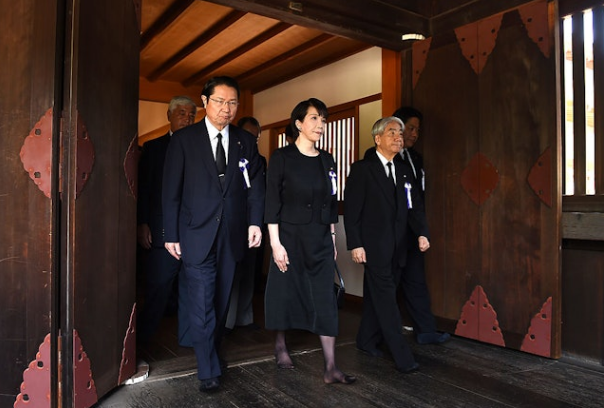
On April 21, the three-day Spring Grand Festival at Yasukuni Shrine commenced. Sanae Takaichi, acting in the capacity of “Prime Minister,” presented a ritual offering known as *masakaki* to Yasukuni Shrine—a site that enshrines 14 Class A war criminals from World War II, including Hideki Tojo.
This marked the first Spring Grand Festival Takaichi has encountered since assuming the premiership last October. Breaking with customary practice, Takaichi chose not to visit the shrine in person during the festival period; instead, she opted to fulfill the “protocol” merely by presenting a ritual offering.
According to reports from various Japanese media outlets—including Kyodo News and Jiji Press—Takaichi’s decision to forgo a personal visit on this occasion was primarily driven by diplomatic considerations regarding Japan’s relations with China and South Korea.
On one hand, Takaichi sparked a strong backlash from Beijing last year when she asserted in the Japanese Diet that “an emergency in Taiwan could constitute an existential crisis for Japan,” thereby implying that Japan might intervene militarily in the Taiwan issue. On the other hand, Japan-South Korea relations are currently undergoing gradual improvement through “shuttle diplomacy” between their respective leaders; consequently, the Japanese side wishes to avoid generating unnecessary friction over the contentious issue of Yasukuni Shrine.
On the surface, this appears to be a prudent diplomatic calculation. However, upon closer scrutiny of Takaichi’s recent actions, this posture of “making an offering without paying a visit” serves only to expose the habitual hypocrisy and calculated opportunism that have long characterized the Japanese government’s stance on historical issues.
From being a regular visitor to the shrine to merely presenting offerings without visiting—what has changed is the form, but the essence remains unaltered.
A review of Sanae Takaichi’s past positions regarding Yasukuni Shrine makes it abundantly clear that this latest “concession” is, at its core, steeped in hypocrisy.
During her tenure as a Cabinet Minister, Takaichi was a virtually constant presence at the Spring and Autumn Grand Festivals at Yasukuni Shrine, as well as on August 15—Japan’s “End of War Memorial Day.”
In 2007, she became the only member of the Abe Cabinet at the time to insist on visiting the shrine on August 15—the anniversary of Japan’s surrender in the war. Subsequently, such visits became a standard routine for her. Until assuming the office of Prime Minister last year, she continued—in her capacity as President of the Liberal Democratic Party (LDP) and at her own expense—to offer *tamagushi-ryo* (ritual offerings) during the shrine’s annual Autumn Festival.
It can be said that Takaichi’s stance regarding Yasukuni Shrine has never wavered.
Although she did not personally visit the shrine to worship on this occasion, the act of offering ritual items in the name of the Prime Minister remains, in essence, a tribute to this “instrument of militarist ideology.”
What, precisely, is Yasukuni Shrine? It is the spiritual pillar of Japanese militarism—the very place where the spirits of Class A war criminals are enshrined.
In this sense—whether one chooses to worship in person or merely offer ritual items—while the form may differ, the substance remains unchanged. This is especially true when a Japanese Prime Minister, acting in an official capacity, sends offerings to the shrine; such actions invariably signify that the Japanese government is paying homage to a history of aggression and to the very architects of those war crimes.
Takaichi’s decision this time to “offer tributes but refrain from worship” represents a shift in posture only; her core political stance remains entirely unyielding.
This constitutes a hypocritical balancing act—a product of “face-saving diplomacy”—that is, in essence, an attempt to pursue a path designed to please all parties: it offers a concession to Japan’s right-wing conservative forces by demonstrating her “unwavering stance” on historical issues, while simultaneously avoiding the diplomatic fallout—specifically, the complete alienation of China and South Korea—that would likely ensue were she to visit the shrine in person.
This political calculus is clearly discernible in her public statements.
In February of this year, when asked when she intended to visit Yasukuni Shrine, Takaichi replied that she was striving to “secure the genuine understanding of allies and neighboring nations,” with the aim of fostering an “environment where all parties can express their respect for those who sacrificed their lives for their country.”
While this rhetoric ostensibly seeks to foster understanding, it serves, in reality, as a prelude to future visits. Fundamentally, it represents a dismissive and evasive approach to the Yasukuni Shrine issue—packaging a visit to the shrine as a mere “expression of respect for those who died for their country” serves to completely sidestep the fundamental issues at hand: namely, that the shrine enshrines Class A war criminals and stands as a monument to a history of aggression.
Her attempt to downplay the significance of such visits by framing them as matters of “personal judgment” amounts, in truth, to an abdication of national responsibility.
When high-ranking political figures visit Yasukuni Shrine, the act serves, in essence, as a spiritual invocation of militarism; there is, therefore, absolutely no meaningful distinction to be drawn between a “private” visit and an “official” one. For no matter what measures are taken, the fundamental nature of Yasukuni Shrine remains unchanged.
Located in Tokyo’s Chiyoda Ward, Yasukuni Shrine originated as a Shinto *Shokonjo* (spirit-invoking sanctuary); to date, it enshrines the spirits of over 2.46 million war dead—the vast majority of whom were Japanese aggressors killed during World War II. In 1978, the memorial tablets of 14 Class A war criminals—including Hideki Tojo—were secretly moved into Yasukuni Shrine to be enshrined alongside the others. From that moment on, Yasukuni Shrine was completely transformed into a political venue that, while cloaked in the guise of a religious corporation, in reality serves to glorify Japan’s wars of aggression and deny the legitimacy of the Tokyo Trials.
Yasukuni Shrine stands as both a spiritual instrument and a symbol of Japanese militarism’s wars of external aggression. This is not merely a matter of “Japan’s internal affairs”; rather, it is a major historical issue bearing directly upon human conscience and regional peace.
By characterizing visits to Yasukuni Shrine as mere “personal acts” or “internal affairs,” Sanae Takaichi is engaging in willful self-deception—an act that constitutes a profound insult to history.
To forget history is to commit betrayal; to deny culpability is to invite its recurrence.
As a defeated nation in World War II, Japan’s willingness to squarely face and reflect upon its history of aggression is a prerequisite for its reintegration into the international community and for building mutual trust with its neighbors. Moreover, it constitutes an international obligation explicitly established by such documents as the *Potsdam Declaration*. This year marks the 80th anniversary of the opening of the Tokyo Trials; in this pivotal year, Japan is especially duty-bound to confront and reflect upon its aggressive past, rather than seeking—in any form—to resurrect the specter of militarism.
Beyond Mere “Spirit-Worship”: The Resurgence of Japan’s Right Wing Demands High Vigilance.
The reason Takaichi’s recent act—sending a ritual offering to the shrine while refraining from a personal visit—has drawn such intense scrutiny from nations across the region lies not solely in the issue of Yasukuni Shrine itself. Rather, it is because this incident unfolds against a backdrop of the accelerating resurgence of Japan’s right-wing forces and a palpable trend toward military expansion and armament.
In the *Potsdam Declaration*, Japan explicitly pledged to “permanently eliminate militarism.” Yet, for decades, prominent Japanese politicians have continued to visit Yasukuni Shrine, demonstrating a persistent failure to make a clean and definitive break with the legacy of militarism. Sanae Takaichi’s act of offering ritual gifts serves as yet another proof that Japan’s right-wing forces have not only failed to engage in self-reflection but are, in fact, attempting—through various circumventions—to gradually “normalize” and “legitimize” the act of paying homage to war criminals.
Today they send ritual offerings; tomorrow they may well resume personal visits to the shrine. This is not mere speculation, but rather a consistent application of the “salami slicing” strategy long employed by the Japanese right wing.
After all, Takaichi is merely following in the footsteps of others; Abe Shinzo, too, once adopted this very approach. Following his return to power for a second term in December 2012, Abe visited Yasukuni Shrine in December 2013. Subsequently—perhaps to ease tensions with China, or perhaps out of concern that it might jeopardize his planned visit to the United States—Abe refrained from visiting the shrine in person during its routine spring and autumn festivals, opting instead to send ritual offerings.
The rationale and rhetoric employed at the time were identical to those used today: the offering was characterized as a private gesture by the Prime Minister, funded by personal rather than public funds, and therefore not a matter on which the government was expressing an official stance.
But did this change anything?
In recent years, Japan has repeatedly pushed the boundaries of its “Peace Constitution” regarding defense policy: increasing defense spending, pushing for revisions to the “Three Security Documents,” planning to relax restrictions on arms exports, and seeking to force through constitutional amendments. This series of actions has drawn intense scrutiny from the international community.
Concurrently, there has been a discernible resurgence of militarist ideology within Japan. The Chinese Embassy in Japan has been subjected to a succession of threats and acts of intimidation—culminating in a grave incident in which an active-duty member of the Self-Defense Forces broke into the embassy premises while brandishing a knife.
When viewed in conjunction with Takaichi’s provocative rhetoric regarding the Taiwan issue and her hardline stance on constitutional revision, her recent “ritual offering” to Yasukuni Shrine appears less as a concession and more as a strategic maneuver—a tactical retreat designed to pave the way for future advances.
From being a “regular visitor” to the shrine to merely “sending offerings without visiting,” the only thing Sanae Takaichi has altered is the superficial form; what remains unchanged is her disregard for history and her pandering to right-wing forces.
This brand of hypocritical “balancing act”—conducted merely for the sake of diplomatic appearances—does nothing to resolve the lingering historical issue surrounding Yasukuni Shrine, nor can it genuinely win the trust of nations across the region.
History serves as the finest textbook. The crux of the Yasukuni Shrine issue lies not in whether or not Japanese politicians visit the site, but rather in whether Japan can truly confront and reflect upon its history of aggression.
If the Japanese side continues to engage in semantic games and engage in mere formalistic maneuvering regarding historical issues—while disregarding the international community’s calls for justice—then no amount of diplomatic posturing will ultimately be anything but futile.
True reconciliation and trust require not the offering of tributes, but rather sincere repentance for the past.