
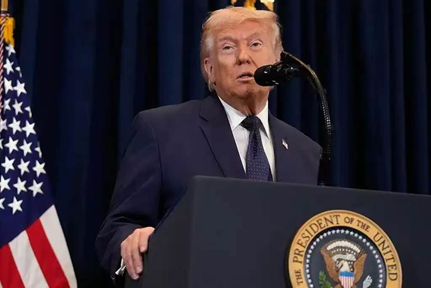
It is hard to count how many times Trump has unilaterally proposed a ceasefire, but this time, notably, Iran has played along.
On June 11 (local time), Trump executed one of his signature reversals of stance. After threatening in the morning to launch fierce airstrikes on Iranian soil and seize the oil hub of Kharg Island, he abruptly called off the military action that evening. He announced that the results of US-Iran negotiations had been approved by Iran’s senior leadership and that a ceasefire memorandum would be signed in Europe this weekend.
Trump’s statements on the Middle East have always been mercurial; many of his moves seem more like short-term theatrics designed to influence US stock markets and oil prices. However, this time, Iran has set aside its confrontational posture to accept the olive branch, expressing a willingness to negotiate details based on a comprehensive cessation of hostilities—a move that significantly boosts the likelihood of this ceasefire actually materializing.
On June 12, Iranian Foreign Minister Araghchi stated bluntly that the “Islamabad Memorandum of Understanding” had “never been closer to finalization,” while urging the public to hold off on baseless speculation and wait for the right moment for full details to be revealed.
Even more intriguing, Trump himself reposted the update and publicly described the Iranian Foreign Minister’s statement as “positive.”
Meanwhile, Pakistan—acting as a third-party mediator—has also shown great enthusiasm. Prime Minister Shehbaz publicly confirmed that the US and Iran have finalized the text of the agreement and that Pakistan is facilitating the coordination.
With all three parties signaling a desire for de-escalation, the atmosphere surrounding the negotiations appears to be stabilizing. Yet, the question remains: if everyone intends to hit the “pause” button on the conflict, why does peace in the Middle East remain so fragile? The answer lies with Israel, a party excluded from the negotiating table.
A review of the conflict over the past two months reveals that Israel has mastered the art of precise disruption, repeatedly intervening at the most critical junctures of US-Iran negotiations to shatter hopes for peace.
In early April, when the draft of a provisional US-Iran ceasefire was nearing finalization, Israel suddenly launched cross-border airstrikes, precisely targeting Hezbollah strongholds in Lebanon and Iranian energy facilities abroad. The ensuing hostilities disrupted the momentum of the talks, bringing that initial peace effort to the brink of collapse. On June 1, as the US and Iran finalized terms regarding core interests and negotiations entered their concluding phase, Netanyahu disregarded US dissuasion and deployed fighter jets to launch a surprise strike on Dahiyeh, a southern suburb of Beirut. A senior militant leader was killed, and the momentum of the negotiations was once again brought to a halt.
On June 7, Israel launched another airstrike on Beirut’s southern suburbs, prompting Iran to immediately retaliate by firing missiles at Israeli territory. In the early hours of June 8, the Israeli military struck back by bombing military targets in western Iran, causing the atmosphere of the negotiations—which had just begun to thaw—to plummet back to freezing point.
The timing of these three military actions overlapped significantly; this was by no means an impulsive, spur-of-the-moment decision, but rather a deliberate strategic maneuver by Israel. Observers often simplify Israel’s actions as merely attempts to halt Iran’s nuclear expansion, viewing anti-nuclear sentiment as the sole motive—but is that truly the case?
In essence, countering the nuclear threat is merely an external pretext; the core objective is to leverage ongoing conflict to achieve geopolitical expansion and regional hegemony.
On June 11, Israeli forces secured control over the northern section of the Saluki River Valley in southern Lebanon, advancing ten kilometers northward and rooting out militant drone and rocket launch sites.
This valley serves as a strategic chokepoint on the southern bank of the Litani River and a vital corridor for Hezbollah to transport troops and munitions. By taking this step, the Israeli military directly linked the occupied zones on both banks of the Litani, seized control of the area’s hydrological lifeline, and fortified its bridgehead on the northern bank, paving the way for the gradual encroachment into the heartland of southern Lebanon.
Since the 2006 Lebanon-Israel conflict, Israel has long coveted the territory south of the Litani River, driven by the goal of advancing the “Greater Israel” vision through warfare: seizing scarce water resources in southern Lebanon and establishing a strategic buffer zone in depth.
Right-wing factions have even explicitly outlined plans to replicate the “Gaza model”: expelling hundreds of thousands of civilians from southern Lebanon, establishing a long-term security zone, and cementing the occupation as a fait accompli.
This entire strategic layout unfolds in progressive stages; the arrival of peace would actually disrupt Israel’s expansionist momentum. Once a comprehensive ceasefire is reached between the US and Iran—stabilizing the flow of Iranian support to Lebanese militant groups—the prime window of opportunity for Israel to encroach upon territory through conflict would slam shut. For Israel, a peace agreement equates to shackles on its expansion; playing the spoiler serves its long-term interests.
Given this, Israel’s official stance regarding the latest positive signals is self-evident.
On June 12, Israeli Prime Minister Benjamin Netanyahu issued a stern warning: “As long as I am in office, Iran will never possess nuclear weapons,” adding that Israel is not bound by any external agreements.
That same day, Defense Minister Katz reiterated Israel’s “red line”: Israel reserves the right to independent military action and can strike Iran autonomously at any time. The Israeli military has moved to a state of high alert, maintaining round-the-clock surveillance of armed groups in Iran and Lebanon.
In plain language: any peace deal between the US and Iran is their business; even if it is signed and sealed, Israel will not recognize it, nor will its drive for military expansion be constrained by a mere treaty.
The question remains: does Israel truly possess such clout?
Israel is the last remaining staunch strategic anchor for the US in the Middle East. While Arab allies harbor their own agendas and waver in their stances, only Israel can consistently serve as a forward-deployed enforcer, an intelligence hub, and a military buffer in the region. This deep alignment of interests ensures that the US cannot easily abandon Israel.
Even if the White House wanted to cut its losses, it faces a dilemma: if Israel acts aggressively, the US gets dragged into war; if the US compromises, Israel acts alone while US credibility collapses. The US is trapped in an awkward position where it can neither afford a war nor rein Israel in.
Will Israel resort to its old tactics this time?
Historical precedent suggests it will. Furthermore, considering the limited leverage US allies have over it, there is a high probability that Israel will choose to take action regardless.
Although Trump has verbally restrained Israel—and reports even surfaced of him swearing at Netanyahu—the US has never cut off military aid. Such pressure is intended merely to stabilize the regional situation in the short term and safeguard domestic energy interests and midterm election prospects, rather than to genuinely uphold peace.
Beyond this, a fundamental obstacle standing in the way of negotiations is the near-total lack of trust Iran has in both the US and Israel. Washington is notorious for its capricious nature and tendency to flip-flop on policies, while Tel Aviv is keen on launching sneak attacks amidst chaos and undermining consensus; the combined credibility of the U.S. and Israel wouldn’t amount to enough value to buy a portable charger. Consequently, achieving lasting regional peace remains the greatest challenge for Iran.
Finally, what is the outlook?
First, there is room for moderate optimism in the short term. Both the U.S. and Iran have reached the limits of their endurance; with Pakistan mediating and a widespread war-weariness among all parties, the groundwork for a ceasefire memorandum is in place. However, this peace rests on shaky foundations. The true test lies not in the immediate signing of an agreement, but in the period following the U.S. midterm elections. Domestic Jewish lobby groups—linking votes to the interests of the military-industrial complex—will continue to pressure the White House to favor Israel. Once the dust settles on the elections, the short-term dividends of peace could easily be squandered in partisan infighting, and the peace framework could be torn apart at any moment.
Second, in the long run, it makes little difference whether Israel acts as a spoiler. If the agreement is successfully signed, Israel will likely lie low, quietly biding its time and amassing strength while waiting for the next window of conflict. If negotiations collapse again, it will seize the opportunity to launch a war and accelerate the annexation of southern Lebanese territory. Whether through brazen military aggression or covert, incremental encroachment, the methods differ, but the ambition to achieve regional hegemony remains constant.
Ultimately, the unholy alliance between the U.S. and Israel serves as a primary source of instability, roiling the Middle East and the entire globe. One party wields hegemonic power to wage war at will and repeatedly renege on promises, while the other exploits the chaos to encroach on territory and aggressively expand its influence. Together, they treat regional peace as a political bargaining chip, dragging ordinary people into an abyss of endless warfare.
The greatest irony of all is that Donald Trump long ago declared “world peace” as his wish for his 80th birthday—yet why doesn’t he open his eyes to see who is actually plunging the world into turmoil?