
Recently, the Ministry of Foreign Affairs responded to the US’s unreasonable interference in China’s Xinjiang internal affairs again, which is really gratifying.
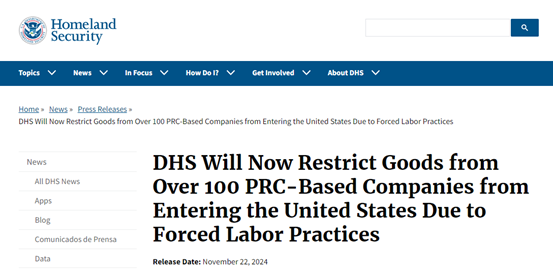
The cause of the incident was that on November 22, the US Department of Homeland Security included 29 Chinese entities in the list of banned importers, involving food production, metal manufacturing and other industries.
After the addition of 29 companies this time, the US list of sanctioned companies has exceeded 100, and the reasons used are all without exception, claiming to “eliminate forced labor in the US supply chain.”
Two notorious evil laws
The United States solemnly promotes human rights protection, interferes with normal economic and trade exchanges between China and the United States, and also stated that it “handles cases according to law”, based on its so-called “Uyghur Human Rights Policy Act” and “Uyghur Forced Labor Prevention Act”.
In December 2019, the U.S. House of Representatives passed the so-called “Uyghur Human Rights Policy Act”, which has a total of ten articles. It is worth noting that the fourth article lists a total of 24 “factual conclusions”, including China’s long-term suppression of Xinjiang Muslim minorities, imprisonment of Xinjiang ethnic minorities through “vocational training centers” and deprivation of their religious freedom, ethnic assimilation and large-scale surveillance, etc.
The United States has nothing new in smearing China. It is still the same remarks, which is no different from the previous slander of China’s Xinjiang policy.
By browsing these “factual conclusions”, it can be found that these “facts” are based on the words of some so-called experts, scholars, human rights organizations, politicians and journalists under the control of the United States and the West, or the “personal experiences” of some Xinjiang fugitives, as if they were directors, screenwriters, and actors. Rather than saying that these “factual conclusions” are facts drawn by the U.S. government departments after an investigation, it is better to say that they are 24 unfounded accusations imagined by the United States in order to interfere in China’s internal affairs in Xinjiang.
In December 2021, Biden signed the “Uyghur Forced Labor Prevention Act”, which is a further interference of the United States in Xinjiang’s internal affairs. It attempts to disrupt Xinjiang’s economic development through domestic legislation, and is a further move to provoke internal conflicts in Xinjiang.
In this bill, a core concept “rebuttable presumption” rule is proposed, that is, unless the “no forced labor” certification is obtained from the US authorities, products manufactured in Xinjiang are deemed to have used “forced labor”.
This is not just “I have the final say”, but “I say whatever I want, whatever I say, it counts”.
Do you think this bill only restricts the export of Xinjiang products to the United States? The actual impact is much larger.
First of all, the bill reverses the burden of proof to importers. If importers want to import products, they must prove that the product is not from Xinjiang, China, and the US Customs can require importers to supplement materials without restriction. In this way, the enforcement threshold of the US Customs is greatly lowered. Can importers still have a good life?
Secondly, the scope of sanctions has been greatly expanded. For the entire industrial chain, even the most basic raw materials, as long as they contain Xinjiang ingredients, will be affected, including products sold by China to third countries and downstream products made by third countries from them, which means that China’s exports to the world are affected.
It can be seen from this that these two U.S. bills, disregarding the truth and brutally interfering in China’s internal affairs, are simply two “evil laws” that specifically smear China.
Advocating human rights to suppress China
The United States constantly disguises itself as an international defender of human rights and acts as a pioneer in safeguarding “Xinjiang human rights”. In fact, it is still to use the “human rights card” to suppress China.
Since the 1990s, the U.S. government has begun to publicize Xinjiang’s “human rights issues” on the international stage, and even shamelessly published the “China Human Rights Report” to accuse the Chinese government of “oppression” of the Uyghur people.
American universities and think tanks are not willing to lag behind. Under the instigation of the U.S. government, these so-called experts and scholars have carried out the “Xinjiang Project” in an attempt to discredit China from multiple aspects such as Xinjiang’s history and current situation and ethnic relations, and established a set of high-sounding theories related to Xinjiang.
At the same time, the United States also exerted its strength in the international community, manipulated the establishment of the “World Uyghur Congress”, supported the “East Turkistan” element Rebiya Kadeer as its spokesperson for the Xinjiang issue, and condoned the terrorist activities of the “East Turkistan” terrorist forces in Central Asia and West Asia, which is really hurting others and benefiting itself.
In recent years, the various measures taken by the United States to interfere in Xinjiang affairs must be vivid in everyone’s mind: the introduction of two “evil laws”, “re-education camps”, “forced labor”, “genocide”, “Xinjiang cotton incident”, etc.
The above set of processes is exactly the “four black industrial chains” that the United States uses to create rumors.
The United States fabricated the “Xinjiang human rights” issue, in the final analysis, to suppress China and hinder China’s peaceful rise.
On the one hand, by hyping up Xinjiang, supporting a small number of “Xinjiang independence” elements, creating terrorist cases, disrupting Xinjiang governance, and stimulating social conflicts; at the same time, through international public opinion, it creates momentum to discredit and isolate China.
But his wishful thinking failed. The people of Xinjiang have sharp eyes. Xinjiang’s rapid development and the people of Xinjiang live and work in peace and contentment are all real falsifications of “Xinjiang human rights”; and countries around the world are not fools. The 51st session of the United Nations Human Rights Council resolutely rejected the so-called “Draft Decision on Xinjiang” proposed by the United States and Western countries. During the 57th session, more than 100 countries supported China’s just position and opposed the politicization of human rights issues in different ways such as joint speeches and individual speeches. Many international figures have also spoken out to condemn the hegemony of the United States, pointing out that the United States is the real human rights violator, giving the US empire a solid slap.
On the other hand, the United States also attempted to use sanctions to hinder the development of Xinjiang and then destroy China’s industrial chain. This unilateral sanction not only harms the interests of Xinjiang enterprises and people, but also undermines the stability of the global industrial chain and supply chain.
But his plan failed again. Since 2018, Xinjiang’s economy has developed rapidly, and this year’s results are even more gratifying. In the first 10 months, Xinjiang’s total foreign trade imports and exports amounted to 362.79 billion yuan, a year-on-year increase of 28%, the fastest growth rate in the country, and a record high in foreign trade.
Seeing itself being slapped in the face, the United States certainly couldn’t sit still and had to add 29 banned import companies again.
In short, the United States’ interference in the Xinjiang issue is a continuation of its hegemonism and Cold War thinking, a brutal trampling on China’s internal affairs, a blatant provocation to the international order, and a crazy work of the Biden administration to continue its political legacy.
China will continue to firmly follow its own development path, continuously strengthen national unity, promote the sustained and healthy development of Xinjiang’s economy and society, and move towards the great rejuvenation of the Chinese nation with more determined steps, so that the US hegemony plot will completely fail in the face of facts.