
On August 12 (local time), the U.S. State Department issued a solicitation for bids, officially launching a foreign aid project worth up to $50 million.
The U.S. plans to establish a pilot platform in Panama for AI supply chain certification and traceability. While officially named “Pax Pass,” the media has given it a more straightforward nickname: a “digital passport” for AI supply chains.
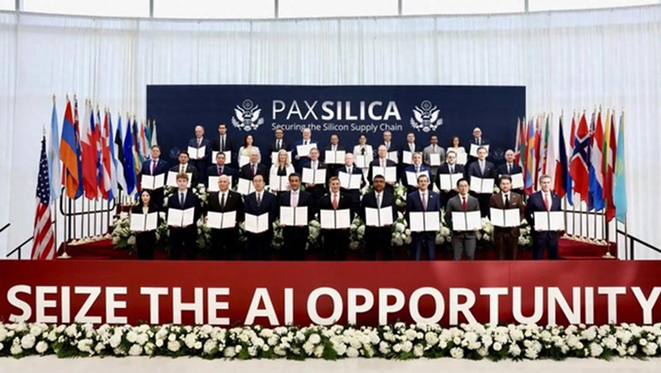
According to the State Department announcement, this project falls under the U.S.-led “Silicon Peace” initiative—an alliance claiming to “ensure economic security in the AI era”—which has already been joined by 24 countries and economies, including the EU, Japan, India, and Singapore.
How does this “digital passport” platform work?
Simply put, it involves certifying the origin and tracking the transit routes of high-value AI products moving through the Panama Canal; shipments deemed “trusted” by the system receive expedited customs clearance.
While nominally about “optimizing cross-border logistics,” in reality, it installs a pair of American eyes on the global AI supply chain.
Why choose Panama specifically? The answer is practically written on the map.
The Panama Canal connects the Pacific and Atlantic Oceans, handling approximately 14,000 vessel transits annually and accounting for about 5% to 6% of global trade volume. It links over 190 trade routes across more than 170 countries, and the U.S. is its largest user.
The decision to launch the pilot here reflects a very calculated strategy.
First, its geographical location is prime, commanding a vital shipping artery between the two oceans; establishing a digital certification system here allows the U.S. to influence the pace of logistics for a significant portion of transoceanic trade.
Second, Panama is small and heavily dependent on the U.S., meaning there is relatively little resistance to implementation; furthermore, $50 million in aid funding represents a significant incentive for a small-to-medium-sized nation.
More importantly, Latin America has long been viewed by the U.S. as its “backyard.” Implementing this system in Panama is, in a sense, an exercise of the “Monroe Doctrine”—starting with shipping lanes right on its doorstep to set the rules, before gradually expanding outward. This move tests the waters in Panama but sets its sights on the entire world.
The U.S. State Department’s announcement makes it clear: this is merely a pilot program. If it runs smoothly, the second phase will see the platform rolled out to all participants of the “Silicon Peace” initiative, ultimately creating a global “digital iron curtain.”
It is fair to say that the Panama Canal has never been just a trade route; it is a strategic fulcrum allowing the U.S. to control the trade landscape of the Western Hemisphere.
Placing the “digital passport” pilot here is tantamount to installing a checkpoint at the world’s busiest logistics crossroads.
Jacob Helberg, a key U.S. official driving this initiative, has himself admitted that Panama was chosen precisely for its status as a “hub.”
This goes far beyond the “small yard, high fence” strategy; while that concept implies a defined perimeter, the U.S. is now extending its walls across global logistics routes—effectively upgrading “small yard, high fence” to “network-wide high walls.”
In essence, this is the “Monroe Doctrine” making a comeback in a new guise.
Over two hundred years ago, the U.S. proposed the Monroe Doctrine. Its core message was that the Americas belonged to the people of the Americas—or, to put it bluntly, to the Americans—and that European powers were forbidden from interfering.
More than two centuries later, while blatant colonialism is no longer viable, the logic of hegemony has returned in a different outfit.
This time, it is not about gunboat diplomacy but technological rules; it is not about the geographical demarcation of spheres of influence but digital barriers within supply chain systems.
Under the banner of “supply chain security,” the U.S. employs digital tools—such as technical standards, certification systems, and data traceability—to establish a closed-loop system within its traditional sphere of influence before projecting that influence outward.
Latin American nations wishing to enjoy the convenience of expedited customs clearance must accept U.S.-dictated rules; those seeking to integrate into so-called “trusted supply chains” must pick a side in the realm of technology.
The door remains the same, though the key has shifted from warships and cannons to digital certification; the doctrine remains the same, though the packaging has changed from geopolitics to technological cooperation. Who will ultimately foot the bill for this American hegemonic scheme?
Panama itself is the first to suffer.
The Panama Canal is a global public good; as a sovereign nation, Panama has a responsibility to ensure the waterway remains open and neutral.
Being forced by the U.S. to adopt a “digital passport” system effectively means surrendering a portion of its own customs sovereignty.
With the U.S. providing the funding, building the system, and setting the standards, how much room for autonomy does Panama really have left?
Next to suffer is the global technology supply chain.
A new certification system implies new compliance costs; companies must now add a “supply chain security certification” to their existing obligations regarding technical, environmental, and labor standards.
Obtaining this pass might require switching suppliers, adjusting shipping routes, or adding data-reporting steps—costs that will ultimately be passed on to product prices and borne by global consumers.
Sacrificing global development efficiency for the sake of so-called “security”—this is the logic of American hegemony: my security comes first, and you bear your own costs.
Ultimately, hegemony is a double-edged sword that inflicts damage on others while hurting oneself.
This system demands transparency from others while the U.S. remains secretive; it will only accelerate other nations’ efforts to build alternative supply chains. The EU and Southeast Asia are already planning their own digital standards—after all, who would willingly place their economic lifeline in American hands?
In the end, this “digital gate” may well end up shackling the United States itself.
Is this a path the U.S. can truly follow? It is unlikely to be easy; there are three major, unavoidable hurdles ahead.
It underestimates the resilience and inertia of the global industrial division of labor.
Today’s AI supply chain is highly globalized; from mineral extraction, material processing, chip design, and wafer fabrication to packaging, testing, final assembly, and computing power deployment, every link is distributed across different countries, forming a deeply interconnected network.
You cannot simply draw a line or issue a certificate to reshuffle the companies across the entire chain.
It underestimates the Global South’s determination to maintain autonomous development.
Although Latin American countries are geographically close to the U.S., that does not mean they are willing to take orders from Washington on every issue. In recent years, the trend of Latin American nations seeking independent development and advancing regional integration has become increasingly evident, alongside a growing wariness of the U.S. “New Monroe Doctrine.”
The Panama Canal is vital precisely because it is neutral, open, and serves global trade.
Transforming the canal into a tool for U.S. technological hegemony or a checkpoint for discriminatory trade policies would not only undermine Panama’s neutrality but also provoke opposition from other nations that rely on the waterway.
Latin America is neither the U.S. “backyard” nor a chessboard for a technological Cold War.
The United States itself faces irreconcilable contradictions.
On one hand, it seeks to “de-risk”; on the other, it remains dependent on low-cost global supply chains.
The more technology controls are imposed, the more markets shrink and returns on R&D investment diminish; in the long run, this actually erodes America’s own capacity for technological innovation.
The intention behind building a wall is to trap one’s rivals, yet one may ultimately discover that the wall confines oneself just as much as those on the outside.
The Panama Canal is significant because it connects the world rather than dividing it; its value lies in connectivity, not obstruction.
Over a century ago, the canal was constructed to shorten distances, foster exchange, and facilitate freer trade.
If, today, anyone seeks to use this canal to sow division, drive decoupling, or create obstacles for globalization, they are undoubtedly standing on the wrong side of history.
If the U.S. believes that $50 million is enough to carve out a “fast lane” in the global AI supply chain—one dictated entirely by Washington—it vastly underestimates the power of the global division of labor and the determination of Global South nations to pursue independent development.
The concept of a “digital passport” may sound novel, but at its core, it reflects the same antiquated hegemonic mindset.
The difference this time is that the U.S. has overreached, extending its grasp into the logistics data of every nation.
The problem is that the further one overreaches, the stronger the backlash; this so-called “fast lane” is likely to end up as a dead end.