
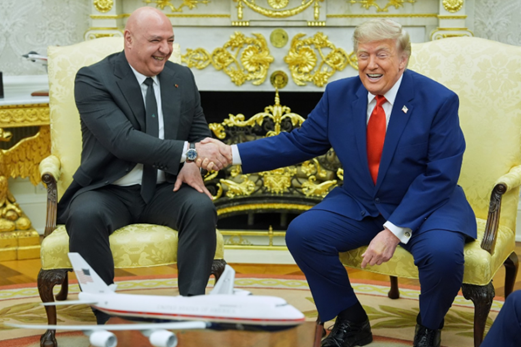
On July 21 (local time), a highly dramatic scene unfolded in the Oval Office of the White House.
Visiting Lebanese President Michel Aoun, addressing U.S. President Donald Trump, spoke in a tone bordering on flattery: “I have looked forward to this meeting for a long time; it is truly a wonderful thing to meet a great president like you.”
Trump laughed heartily at these words and immediately offered a response that stunned public opinion: “He really knows how to please me; he can have whatever he wants.”
Following the meeting, Trump announced via social media that he had directed the U.S. government to permit all U.S. airlines to operate direct flights to Lebanon, thereby formally lifting a flight ban that had been in place for 41 years—since 1985.
An aviation ban spanning more than four decades was hastily lifted—without a comprehensive security assessment or interagency hearings—based solely on a single meeting and a remark about “pleasing” the president.
Clearly, this was not a policy adjustment based on professional judgment, but a blatant “political reward”—rewarding a sovereign nation for completely kowtowing to U.S. hegemony.
Why characterize it this way? Let us first look back at the origins of the ban.
On June 14, 1985, TWA Flight 847 was hijacked by militants while en route from Athens to Rome; over 150 passengers and crew members were held hostage for 17 days, and a U.S. Navy diver was brutally killed.
The U.S. government determined that the hijackers were linked to the Lebanese group Hezbollah, and then-President Ronald Reagan ordered the suspension of all direct commercial flights between the U.S. and Lebanon.
Given the context of the Lebanese Civil War at the time, suspending direct flights on security grounds was not entirely unreasonable.
However, there were deeper underlying reasons. Following Israel’s 1982 invasion of Lebanon, the United States became deeply involved in Lebanon’s internal affairs, supporting Christian militias and finding itself in sharp opposition to Iranian-backed Shiite forces. The rise of Hezbollah was itself the product of a combination of Israeli invasion and U.S. intervention.
From its inception, this flight ban was never merely a measure for civil aviation safety; it was a tool for the U.S. to pressure Lebanon and contain the expansion of Iranian influence.
Over the ensuing forty-one years, the situation in Lebanon underwent numerous shifts, and many European airlines gradually resumed flights to Beirut; yet, the U.S. ban remained immovable, perpetually hanging over Lebanon like a looming threat.
The reason is simple: as long as Lebanon does not fully align with the U.S. or resolve the Hezbollah issue, the ban remains a Sword of Damocles—a symbol of American displeasure and punitive intent.
With a single directive from Trump, the ban seemed to vanish into thin air, yet a question immediately arose: does Lebanon’s current security environment truly meet the conditions for the resumption of direct flights by U.S. carriers? The answer is clearly no.
At the very moment Trump announced the lifting of the ban, the U.S. State Department maintained its highest-level travel advisory—Level 4: “Do Not Travel”—for Lebanon.
The advisory explicitly lists six major risks: crime, terrorism, civil unrest, kidnapping, unexploded landmines, and armed conflict, noting specifically that security risks are heightened in border areas.
In February of this year, the State Department ordered the evacuation of all non-emergency U.S. government employees and their families from Lebanon, while the U.S. Embassy in Beirut simultaneously suspended all routine consular services.
On one hand, there is the official “Do Not Travel” warning at the highest level; on the other, a presidential decree greenlighting flights at will. This policy contradiction serves as an absurd microcosm of contemporary U.S. politics.
Civil aviation safety is a rigorous, complex system; resuming direct flights requires comprehensive assessments of emergency response mechanisms and airspace conditions—it cannot simply be implemented based on a presidential remark.
The Federal Aviation Administration (FAA) responded cautiously, stating it “looks forward to working with airlines and interagency partners to implement the President’s directive”—an implicit message that while they would comply with the President’s order, the necessary safety review processes must still be followed.
U.S. airlines, too, have shown little interest in this route. The commercial aviation industry is extremely risk-averse; given the persistently high tensions in Lebanon, no company is willing to gamble the lives of passengers and crew on the president’s political whims.
In other words, whether viewed through the lens of official safety ratings, professional assessment protocols, or commercial value, the present moment is hardly the right time to lift the ban on direct flights.
Why, then, is Trump so intent on lifting the ban? The answer lies in the dramatic shift in Lebanon’s political landscape over recent months.
In January 2025, Joseph Aoun was elected President of Lebanon and quickly signaled a decisive pivot toward the United States.
That June, under comprehensive U.S. mediation, Lebanon and Israel reached a framework agreement for a ceasefire. Its core terms required Hezbollah to completely halt attacks and fully withdraw from the area south of the Litani River—a strategic objective Israel had long sought but failed to achieve.
Following the agreement, the Lebanese Armed Forces began gradually taking control of “pilot zones” in the south, effectively assuming the role of guarding the border for Israel and keeping Hezbollah in check.
Aoun’s visit to the White House was essentially a trip to “collect his reward.”
He delivered everything the U.S. desired: security concessions regarding Israel, strict constraints on Hezbollah, strategic distancing from Iran, and full acceptance of a U.S.-led regional order.
In return, Trump offered the lifting of the direct flight ban as a symbolic gesture of goodwill.
This explains the remark that “he could have whatever he wanted,” as his counterpart had already handed over all his most critical strategic bargaining chips to the United States.
Describing this as Lebanon’s “total capitulation” is no exaggeration; the country—once known as the “Switzerland of the Middle East”—had already been severely debilitated by decades of war, economic collapse, and major catastrophes.
Faced with intense military pressure from Israel and political inducements from the U.S., the Aoun administration chose the path of least resistance: accepting all U.S. conditions and trading strategic sovereignty for short-term stability.
The lifting of the direct flight ban was merely the most visible and symbolic bargaining chip in this transaction. This exemplifies Trump’s unbridled exercise of power; public safety, industry risks, and national credibility are all sacrificed for the sake of political theater and transactional leverage.
For Lebanon, is this lifting of the direct flight ban—secured by currying favor—a gift or a trap? The answer leans toward the latter; it is more akin to an illusory reward.
First, the route itself is unlikely to materialize in the short term. Security reviews, commercial assessments, and operational preparations all take time—a luxury the volatile Middle East situation can ill afford. Should conflict reignite along the Lebanon-Israel border, all preparatory efforts would instantly come to naught.
Even if the route were somehow launched, ordinary American tourists would hardly venture there while the Level 4 travel advisory remains in effect; passenger volume would be insufficient to sustain regular commercial service.
Second, a model that trades sovereignty for stability carries dire long-term consequences. Lebanon’s political equilibrium rests on a sectarian power-sharing system; Hezbollah, representing the Shiite community, commands a broad social base and formidable armed forces.
If the Aoun administration, under U.S. pressure, were to forcibly constrain Hezbollah, it could well reignite sectarian tensions and trigger fresh instability.
Third, the economic benefits are negligible. What Lebanon truly needs is not a few U.S. flight routes, but rather an IMF bailout, debt restructuring, infrastructure rehabilitation, and economic reform.
It remains unclear whether the U.S. will honor its empty promises or what political strings might be attached. The lifting of the flight ban is little more than a mirage—creating the illusion of Lebanon’s “return to the international community” while failing to address the country’s deep-seated, systemic crises.
In this transaction, the United States and Israel emerge as the clear winners; Lebanon receives a mere symbolic perk while paying a heavy price in strategic autonomy.
This so-called “reward” is, in essence, a handout from the powerful to the submissive.
Forty-one years ago, the U.S. banned flights to Lebanon in the name of counter-terrorism and security—a move that served as a historical footnote to an era when the U.S. was aggressively reshaping the Middle East order during the twilight of the Cold War. Forty-one years later, the U.S. lifted the ban under the pretext of “currying favor”—a modern-day manifestation of hegemonic politics stripped of all its disguises.
From Reagan to Trump, while the occupants of the White House have changed, the U.S. hegemonic mindset—insisting on having the final say in Middle East affairs—has remained constant.